Category Archives: Main

“Christians, Muslims join voices in Tahrir Prayer”

February 6, 2011

CAIRO: Christians and Muslims recited in unison the “Our Father” prayer in Tahrir on Sunday, a day intended to commemorate those killed in pro-democracy protests since Jan. 25. Egypt’s Protestant Asr El-Dubara Church has played a big role in calling for a Christian prayer in the central Tahrir Square, in which protesters have camped since Jan. 25. Protestant preacher Ihab El-Kharat led two sermons at 1 and 2 pm at the Square.
“This is a blessed land. … Peace will always prevail in this country,” he told the tens of thousands that flocked to Tahrir, or Liberation Square.

For More >CLICK HERE<

Video surfaces of Houston’s teen police beating

February 5, 2011

(CNN) — Houston’s mayor and police department were on the defensive Friday, two days after graphic video came out showing several officers repeatedly kicking and beating a 15-year-old burglary suspect as he lay on the ground. An internal police investigation of the incident last March led to the firing of seven police officers, said spokesman John Cannon of the Houston police department. Two successfully appealed and returned to their jobs, said Houston NAACP President D.Z. Cofield. Five other officers were disciplined in other ways, Cannon said. A Harris County grand jury indicted four of the officers this summer, based in part of the video. Harris County District Attorney Patricia Lykos opposed the video becoming public and felt doing so might prejudice potential jurors and force the indicted officers’ trials to be moved out of the county. Quanell X, a local activist, got hold of the surveillance tape showing the scene outside a storage facility and gave it to the media.

He said he had every right to obtain the footage and make it public. “I will show my people what they deserve to see, and let the public see what you don’t want them to see,” Quanell X said. Mayor Annise Parker said the police leadership and city acted properly. “I resent any implication that we were trying to hide the tape,” she said. After viewing the footage, Houston Police Chief Charles McClelland Jr. fired the seven officers and a grand jury called for misdemeanor charges against four of them in June on misdemeanor charges. Lykos told reporters Thursday there was not sufficient evidence to pursue more serious charges, such as aggravated assault. “Without revealing what was presented to the grand jury, in order to have aggravated assault you have to have serious bodily injury or impairment or use of a deadly weapon,” she said. “None of that was apparent in this case.” The tape, first shown Wednesday on CNN affiliate WTRK, shows the 15-year-old boy — being chased by police and falling to the ground after being upended by a moving police car. He then falls face first and places his hands on the ground.

A disciplinary letter from McClelland, dated June 23 and posted online less than two weeks later by CNN affiliate HTRK, says that the boy had his hands behind his head and neck area, in an obvious position of surrender. Then, the letter adds and the tape shows, Officer Raad Hassan “then ran toward (the boy) and kicked him a total of 15 times,” then later kicked him more times in the groin area even after he “was handcuffed and no longer a threat.” Several other officers, repeatedly kicking and punching the 15-year-old, who barely moved the whole time. Like Parker, the head of Houston’s police union said the incident did not reflect on the make-up or usual activity of officers on the force. “We have thousands of officers who do a great job every day and they’re not involved in this,” said Mark Clark, the union’s executive director. “It’s serious and it’s a reflection on the department.” Cofield sharply criticized the police officers’ actions as well as how civic leaders had handled the case afterward during a news conference Thursday. That includes officials’ unwillingness to make the tape public. “For us, what seems to be a tragedy (is) repeated one more time in Harris County,” he said.

“Egyptian unrest and US media bias”

For more videos >CLICK HERE<

Egypt Protests on February 4 – Al Jazeera Coverage

Egypt protest Feb 4, 2011 (12 Parts)

CONTINUED ON EGYPT PAGE >CLICK HERE<

‘Day of departure’ rally in Egypt

FOR MORE NEWS VISIT EGYPT PAGE –  CLICK HERE

New Page for Egypt

A new page called “Egypt” has been created which will make it easier for people to see all the content relating to Egypt in one place.  The link for this new page is shown below.

http://4TheRecord.org/Egypt/

Egypt: Mubarak starts the Crack Down on Journalists and Human Rights Groups

Major Ahmed Mahmoud Abdel Meguid has been caught attempting to burn down the  National Museum

Egypt violence exposes secret tools of state repression

International journalists covering events in Egypt this week have had a small but painful taste of “the dark side” – the secret security apparatus used by governments across the region, day in day out, to keep unpopular rulers in power. The BBC, CNN and several Arab media organisations have all been experiencing harassment, crude and at times violent, by plain clothes “thugs” supporting President Hosni Mubarak. On Wednesday the BBC’s Rupert Wingfield-Hayes was handcuffed, hooded and interrogated, while another journalist, from Al-Arabiya TV, was beaten so badly by plain clothes men he had to be hospitalised. Local opposition figures would simply say: “Welcome to our world.”

Whether it is the official secret police of the State Security Institution (SSI), the intelligence agents of the Mukhabaraat, or just hired street thugs, these instruments of power have long been used to intimidating effect on those opposing the government or even speaking out about human rights abuses. Tom Porteous, UK Director of Human Rights Watch (HRW), told the BBC: “State repression and abuse are coming out of the torture chambers and onto the streets”. In its just-published 2011 review of human rights around the world, HRW accuses Egypt’s secret police and uniformed police alike of routine, systematic torture of prisoners. “This is used both to extract confessions,” says Mr Porteous, “and as an instrument of punishment and deterrent”.

We’ve compiled a list of all the journalist who have been in some way threatened, attacked or detained while reporting in Egypt.  When you put it all into one list, it is a rather large number in such a short period of time.  (UPDATED – send us more stories if you get them)

APTN had their satellite dish agressively dismantled, leaving them and many other journalists who rely on their feed point no way to feed material.

ABC News international correspondent Christiane Amanpour said that on Wednesday her car was surrounded by men banging on the sides and windows, and a rock was thrown through the windshield, shattering glass on the occupants. They escaped without injury

And ABC Producer and Cameraman driving were carjacked at a checkpoint and driven to a compound where they were surrounded by men who threatened to behead them.  They were able to convince the men to release them without any harm. 

ABC/Bloomberg’s Lara Setrakian also attacked by protesters

CNN’s Anderson Cooper said he, a producer and camera operator were set upon by people who began punching them and trying to break their camera/  (wires)

Another CNN reporter, Hala Gorani, said she was shoved against a fence when demonstrators rode in on horses and camels, and feared she was going to get trampled/ (wires)

Fox Business Channel’s Ashley Webster reported that security officials burst into a room where he and a camera operator were observing the demonstration from a balcony. They forced the camera inside the room. He called the situation “very unnerving” and said via Twitter that he was trying to lay low    / (wires)

Fox News Channel foreign correspondent Greg Palkot and producer Olaf Wiig were hospitalized in Cairo after being attacked by protestors.   

CBS News’ Katie Couric harassed by protesters   (link)

CBS newsman Mark Strassman said he and a camera operator were attacked as they attempted to get close to the rock-throwing and take pictures. The camera operator, who he would not name, was punched repeatedly and hit in the face with Mace.  / (wires)

CBS News’ Lara Logan reports she was marched back to her hotel at gunpoint when she and a crew were taking pictures of protests (link)  Time Magainze reports that Lara Logan has been detained by Egyptian police.  (link)

Two New York Times journalists have been arrested. (A Times spokeswoman said that the two journalists were “detained by military police overnight in Cairo and are now free.” )     (link)

Washington Post foreign editor Douglas Jehl wrote Thursday that witnesses say Leila Fadel, the paper’s Cairo bureau chief, and photographer Linda Davidson “were among two dozen journalists arrested this morning by Military Police.”  Fadel and Davidson have since been released.  /   (link)

BBC’s Jerome Boehm also targeted by protesters / (link)

BBC also reported their correspondent Rupert Wingfield-Hayes’ car was forced off the road in Cairo “by a group of angry men.” He has detained by the men, who handed him off to secret police agents who handcuffed and blindfolded him and an unnamed colleague and took them to an interrogation room. They were released after three hours. /   (link) 

Reporter Jean-Francois Lepine of Canada’s CBC all-French RDI network said that he and a cameraman were surrounded by a mob that began hitting them, until they were rescued by the Egyptian army   / (wires)

The Toronto Globe and Mail said on its website that one of its reporters, Sonia Verma, said the military had “commandeered us and our car” in Cairo/ (link)

Two Associated Press correspondents were also roughed up. AP’s Nasser Gamil mentioned in one article (unclear if he was one of the original 2 mentioned)  / wires and (link)

Reuters’ Simon Hanna tweeted today that a “gang of thugs” stormed the news organization’s Cairo office and being smashing windows    (link)

The website of Belgium’s Le Soir newspaper said Belgian reporter Serge Dumont, whose real name is Maurice Sarfatti, was beaten Wednesday / (wires)

Jon Bjorgvinsson, a correspondent for RUV, Iceland’s national broadcaster, but on assignment for Swiss television in Cairo, was attacked on Tuesday as he and a crew were filming/ (link)

Danish media reported that Danish senior Middle East Correspondent Steffen Jensen was beaten today by pro-Mubarak supporters with clubs while reporting live on the phone to Danish TV2 News from Cairo / (link) 

Two Swedish reporters (from Aftonbladet tabloid) / (link)

epa photojournalist; German ZDF; German ARD / (link)

A reporter for Turkey’s Fox TV, his Egyptian cameraman and their driver were abducted by men with knives while filming protests Wednesday, but Egyptian police later rescued them, said Anatolia, a Turkish news agency /  (link)

Turkey’s state broadcaster TRT, said its Egypt correspondent, Metin Turan, was beaten / (link)

One Greek print journalist was stabbed in the leg with a screwdriver / (wires)

*note: unclear if this is the same person identified in another: The injured Greek journalist, Petros Papaconstantinou, said on Kathimerini’s website that: “I was spotted by Mubarak supporters. They … beat me with batons on the head and stabbed me lightly in the leg.

A Greek freelance photographer punched in the face by a group of men who stopped him on the street near Tahrir Square and smashed some of his equipment / (wires)

In addition, five Chinese journalists were briefly detained after authorities found bullet proof vests in their luggage, along with more than 20 walkie-talkies and satellite phones, the officials said. They were allowed to leave after the equipment was confiscated. / (wires)

RT TV crew injured  (link)

A correspondent and a cameraman working for Russia’s Zvezda television channel were detained by men in plainclothes and held overnight Tuesday, Anastasiya Popova of Vesti state television and radio said on air from Cairo / (link)

French international news channel France 24 said three of its journalists had been detained while covering protests in Egypt and were being held by “military intelligence services”.  (link)

French photojournalist from SIPA Press agency Alfred Yaghobzadeh is being treated by anti-government protestors after being wounded during clashes between pro-government supporters and anti-government protestors / (link)

Police arrested four Israeli journalists for allegedly violating the curfew in Cairo and for entering the country on tourist visas, according to news reports. / (link)

Al Jazeera reported Thursday that two of its reporters were attacked en route to Cairo airport, along with cameraman being assaulted near Tahrir Square /    (link) 

al Arabiya’s Ahmed Abdullah (and station was stormed) /  (link)

ALSO – Al-Arabiya correspondent, Ahmed Bajano, in Cairo, was beaten while covering a pro-Mubarak demonstration. Another unidentified correspondent was also attacked. Another network reporter said on the air that her colleague Ahmad Abdel Hadi was seized by what appeared to be pro-Mubarak supporters near Tahrir Square, forced in a car, and driven away.  / (link)

Men in plainclothes surrounded the office of Sawsan Abu Hussein, deputy editor of the Egyptian magazine October after she called in to a television program to report on violence against protesters   (link)

A group of men described as “plainclothes police” attacked the headquarters of the independent daily Al-Shorouk in Cairo today, the paper reported. Reporter Mohamed Khayal and photographer Magdi Ibrahim were injured/ (link)

 – Compiled by ABC’s Erin McGlaughlin and Joanna Suarez

Amnesty International representatives detained in Cairo

3 February 2011

Two Amnesty International representatives have been detained by police in Cairo after the Hisham Mubarak Law Centre was taken over by military police this morning. The Amnesty International staff members were taken, along with Ahmed Seif Al Islam, Khaled Ali, a delegate from Human Rights Watch and others, to an unknown location in Cairo.  Amnesty International does not know their current whereabouts. “We call for the immediate and safe release of our colleagues and others with them who should be able to monitor the human rights situation in Egypt at this crucial time without fear of harassment or detention,” said Salil Shetty, Secretary General of Amnesty International.

Journalists get attacked, arrested in Egypt

Supporters of Egyptian President Hosni Mubarak attacked pro-democracy protesters and targeted journalists in Cairo on Wednesday. The Cutline reported yesterday on pro-Mubarak mobs going after journalists from CNN, CBS, ABC and numerous international news outlets. The media crackdown seems to be accelerating today. So far, there have been several reports on Twitter indicating that pro-Mubarak mobs have attacked journalists and bloggers—and that some journalists have also been arrested by Mubarak’s much-feared police force. But it’s not only the police arresting members of the media. The AP reports that the Egyptian military is rounding up journalists, with correspondent Hadeel Al-Shalchi tweeting that two New York Times journalists have been arrested. (A Times spokeswoman said that the two journalists were “detained by military police overnight in Cairo and are now free.” ) Also, Washington Post foreign editor Douglas Jehl wrote today that witnesses say Leila Fadel, the paper’s Cairo bureau chief, and photographer Linda Davidson “were among two dozen journalists arrested this morning by the Egyptian Interior Ministry.” (They were later released).

The AP reported today that Mubarak supporters stabbed a Greek journalist with a screwdriver and punched a freelance photographer. Also, Al Jazeera reported today that two of its reporters were attacked en route to Cairo airport, along with cameraman being assaulted near Tahrir Square. “There is a concerted campaign to intimidate international journalists in Cairo and interfere with their reporting,” State Dept. spokesman Philip Crowley wrote on Twitter. “We condemn such actions.” The White House has also condemned attacks against journalists. “The administration strongly condemns the violence today and strongly condemns violence against journalists in Egypt,” press secretary Robert Gibbs told The Cutline Wednesday. CNN’s Anderson Cooper described “pandemonium” Wednesday as his crew was attacked. Reuters’ Simon Hanna tweeted today that a “gang of thugs” stormed the news organization’s Cairo office and being smashing windows. Also, Hanna wrote that “two army men came into the building with guns, kicked out the thugs but were shouting and swearing at us.” Both Committee to Protect Journalists and ABC News each have running lists of journalists attacked: here and here.

There have been several reports over Twitter that Mubarak’s police have arrested “Sandmonkey,” a prominent Egyptian blogger and critic of the regime.  Just yesterday, he spoke to Pajamas Media TV about evading police officials who were apparently looking for him. (Later, Sandmonkey wrote on Twitter: I am ok. I got out. I was ambushed & beaten by the police, my phone confiscated , my car ripped apar& supplies taken #jan25). Mubarak’s authoritarian regime has long repressed the media and his police forces attacked journalists during last Friday’s major demonstration. The Egyptian government also shut down Al Jazeera’s Cairo bureau Sunday, following the network’s exhaustive coverage since the uprising began. On Monday, The Cutline spoke with Amanpour, Cooper and other journalists in Egypt. At the time, they had been covering largely peaceful demonstrations staged by pro-democracy protesters. But now, with pro-Mubarak protesters on the streets, journalists aren’t safe. Richard Engel, the chief foreign correspondent for NBC News, wrote the following on Twitter today: “Journalists, now targets, disliked by mubarak supporters, forced to play cat-mouse game, broadcasting, moving, staying low profile.”

Vodafone: Egypt forced us to send text messages

LONDON – Egyptian authorities forced Vodafone to broadcast pro-government text messages during the protests that have rocked the country, the U.K.-based mobile company said Thursday. Micro-blogging site Twitter has been buzzing with screen grabs from Vodafone’s Egyptian customers showing text messages sent over the course of the demonstrations against Egyptian President Hosni Mubarak’s 30-year-old regime. A text message received Sunday by an Associated Press reporter in Egypt appealed to the country’s “honest and loyal men to confront the traitors and criminals and protect our people and honor.” Another urged Egyptians to attend a pro-Mubarak rally in Cairo on Wednesday. The first was marked as coming from “Vodafone.”

The other was signed: “Egypt Lovers.” In a statement, Vodafone Group PLC said that the messages had been drafted by Egyptian authorities and that it had no power to change them. “Vodafone Group has protested to the authorities that the current situation regarding these messages is unacceptable,” the statement said. “We have made clear that all messages should be transparent and clearly attributable to the originator.” The company also said its competitors — including Egypt’s Mobinil and the United Arab Emirates’ Etisalat — were doing the same. Etisalat, known formally as Emirates Telecommunications Corp., declined comment. Vodafone said the texts had been sent “since the start of the protests,” which kicked off more than a week ago. Vodafone did not immediately return an e-mail asking why the company waited nearly 10 days to complain publicly. Its statement was released only after repeated inquiries by the AP.

Vodafone complains after Egyptian government forced it to broadcast pro-Mubarak text messages during riots

Vodafone says the Egyptian authorities forced it to broadcast pro-government text messages during the protests that have rocked the country. It called the practice ‘unacceptable’ and confirmed protests had been made to the government. Twitter has been buzzing with screen grabs from Vodafone’s Egyptian customers showing pro-government text messages sent to them in the run-up to the violent clashes in central Cairo which broke out on Wednesday. Vodafone Group said in a statement today that Egyptian authorities have been using the country’s emergency laws to script text messages to its customers.
The UK-based company said it had no ability to change the content of the messages. Vodafone’s statement came as violent scenes erupted in Cairo again today as hired thugs and secret police loyal to the beleaguered President Hosni Mubarak continued to clash with protesters calling for regime change. It is believed as many as 300 people have died during the regime change protests. ‘Vodafone Group has protested to the authorities that the current situation regarding these messages is unacceptable,’ the statement said. ‘We have made clear that all messages should be transparent and clearly attributable to the originator.’

The company noted in its statement that the Egyptian government also has the power to compel other mobile operators, including Egypt’s Mobinil and Etisalat, to send pre-scripted text messages. It was not clear whether those companies were also involved. Vodafone did not immediately return a call seeking comment on the exact nature of the government messages, although Twitter users described them as carrying patriotic messages as well as attacks on ‘traitors’. A text message received on Sunday by an Associated Press reporter in Egypt appealed to the country’s ‘honest and loyal men to confront the traitors and criminals and protect our people and honour’. The sender is identified only as ‘Vodafone’.

Vodafone network ‘hijacked’ by Egypt

Mobile phone firm Vodafone has accused the Egyptian authorities of using its network to send unattributed text messages supporting the government. Vodafone was told to switch off services last week when protests against President Hosni Mubarak began. But the authorities then ordered Vodafone to switch the network back on, in order to send messages under Egypt’s emergency laws, the firm said. In a statement, Vodafone described the messages as “unacceptable”. “These messages are not scripted by any of the mobile network operators and we do not have the ability to respond to the authorities on their content.”  The Paris-based Organisation for Economic Co-operation and Development says that the government clampdown on internet services may have cost the Egyptian economy as much as $18m (£11m) a day or $90m in total. The impact of the communications block could be even greater, as it would be “much more difficult in the future to attract foreign companies and assure them that the networks will remain reliable”, said the OECD in a statement. In another development, the credit ratings agency Fitch has downgraded the Egypt’s debt grade by one notch to BB from BB+, citing the consequences of the continuing political unrest on the economy. The country’s debt grade has already been downgraded by two other ratings agencies, Moody’s and Standard & Poor’s.

Egypt:Interviews from “Zero Silence” Documentary

A documentary film about young people in the Middle East who have grown angry over the authoritarian regimes they live in and who are using the Internet to bring about change in their societies where free speech is controlled or censored. They are part of a new generation that uses the Internet to get the free word out and to organize, mobilize, collaborate and fight injustice. Among other topics, the production will explore the impact of the Internet and non-traditional media such as Facebook, YouTube, and Twitter and whistle-blowing sites on the Arab world and beyond and to what extent these digital media tools can spur society change.

The Arab world is currently experiencing a wave of unprecedented popular uprisings and street demonstrations against corruption, lack of freedoms, and unemployment. Many of the demonstrators out in the streets are young people and several recent protests have been coordinated on social media sites. We think the Internet is playing an important role in the events that are currently unfolding in the region and that it is partly thanks to social media sites such as Facebook, YouTube, and Twitter, that street demonstrations have become widespread in Tunisia, Algeria, and Egypt to name a few countries.

However, while these digital media tools have helped trigger a domino effect of similar demonstrations throughout the Arab world we believe that it is the power of the young people that will bring about change. The characters in our film show that courage is contagious and that silence is not an option. This is not a film about social media networks but about the revolt of a young generation for whom silence is no longer an option.

Demonstrators at Tahrir Square come under attack by Mubarak’s Thugs killing 2 Demonstrators

“Talked with several soldiers manning barricades around Tahrir. Said they have orders not to allow more pro-Mubarak people near the square.”

White House emboldened by Egypt bloodshed

03:52 GMT,  Thursday, 3 February 2011

Amid the violence on the streets of Cairo one pro-Mubarak demonstrator holds aloft a hand made sign reading “Shut up Obama”. But the disorder on the streets has only sharpened the Obama’s administration appetite for a confrontation. ABC says Obama is “very concerned” that President Hosni Mubarak is delaying. The Wall Street Journal says the White House has a new plan for a speedy transfer of power. The New York Times says the CIA is war-gaming how that will play in the region. However you put it, it amounts to one thing. The White House, as much as the pro-democracy protesters, is demanding “Mubarak must go”. US Secretary of State Hillary Clinton has telephoned the new vice-president and intelligence chief of two decades, Omar Suleiman, to tell him immediately to seize the opportunity for a transition to a more democratic society. That transition must start now. She said that the violence was shocking and told him that they must investigate the violence and hold those responsible accountable.

You might have thought that after all their initial pussyfooting caution, the bloodshed might have given the Obama administration second thoughts about whether it was wise to back the protesters and scorn Mubarak’s promise to go in September. Not a bit of it. If anything it has emboldened it to be more open about its wishes and made it more determined to winkle him out. Others have joined the fray. Shortly after a very rare meeting with the US president, former Republican presidential candidate John McCain issued a statement: “The rapidly deteriorating situation in Egypt leads me to the conclusion that President Mubarak needs to step down and relinquish power. It is clear that the only institution in Egypt that can restore order is the army, but I fear that for it to do so on behalf of a government led by or involving President Mubarak would only escalate the violence and compromise the army’s legitimacy.”

A Western diplomat tells me that their best intelligence suggests that secret police were among those causing the violence and that it was almost certainly orchestrated by those very close to Mubarak. He saw it as a last desperate throw of the dice by a leader who is badly misreading the public mood. There are frantic conversations taking place between Washington and Cairo. We can’t know the details but surely the main players are being urged to action. What happens on the streets is very important. It colours the outcome and may decide it. But short of bloody revolution, only the army and those in Mubarak’s inner circle can force him to go.

Egypt: ‘Two dead’ in overnight gunfire

Gunfire has rung out in the early hours of Thursday around Cairo’s Tahrir Square, where Egyptian anti-government protesters are camping out. At least two people are reported dead. On Wednesday three died in clashes with supporters of President Hosni Mubarak. Hundreds of people were wounded as rival groups fought pitched battles in and around Tahrir Square, in the worst violence in nine days of protests. The protesters are demanding President Mubarak’s resignation. He says he will serve out his current presidential term, his fifth, which ends in September. The unrest has left about 300 people dead across the country over more than a week, according to UN estimates. In a speech on Tuesday night Mr Mubarak – who has been in office for nearly 30 years – promised to leave at the next polls and pledged constitutional reform.

He said he would devote his remaining time in power to ensuring a peaceful transition. US President Barack Obama responded by saying an orderly transition “must begin now”. Opposition leader Mohamed ElBaradei dismissed Mr Mubarak’s move as “a trick” to stay in power, and Tahrir Square protesters have vowed to continue their demonstrations until Mr Mubarak quits. Abdelhalim Kandil, leader of Egypt’s Kifaya (Enough) opposition movement, said Mr Mubarak’s offer not to serve a sixth term was not enough. “I will tell you very simply that there is an unprecedented popular movement that rejects the presence of the president on a scope that has not been seen before, that is calling for the will of the people to be imposed,” he said. If Mr Mubarak does not step down, demonstrators have planned to march on the presidential palace. Meanwhile, internet services were returning to the country, having been cut off for days by the government.

Egypt’s revolution turns ugly as Mubarak fights back

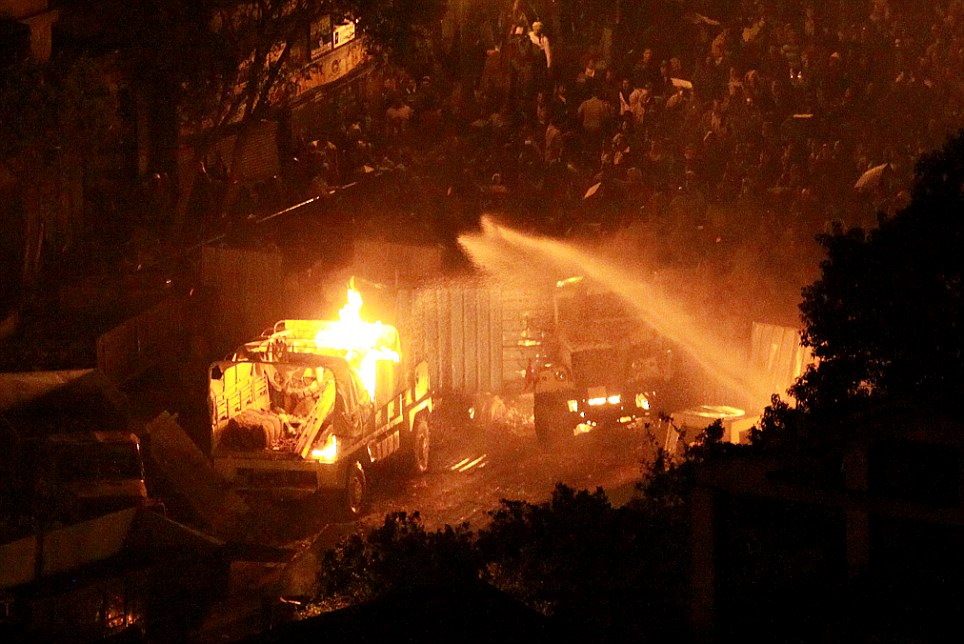
Egypt’s pro-democracy revolution descended into violence and bloodshed overnight as President Hosni Mubarak’s regime launched a co-ordinated bid to wrest back control of city streets, crush the popular uprising, and reassert its authority. Bursts of heavy gunfire rained into Tahir square just before dawn today and there were reports that three more people had been killed. Protest organiser Mustafa el-Naggar said he saw the bodies of three dead protesters being carried toward an ambulance. He said the gunfire came from at least three locations off in the distance and that the Egyptian military, which has ringed the square with tank squads for days to try to keep some order, did not intervene. Another witness said as many as 15 people had been wounded in the fresh clashes. Clashes had continued into the early hours even though the pro-Mubarak supporters had been pushed back to the edge of the square and explosions – possibly from gas canisters – echoed around the area.

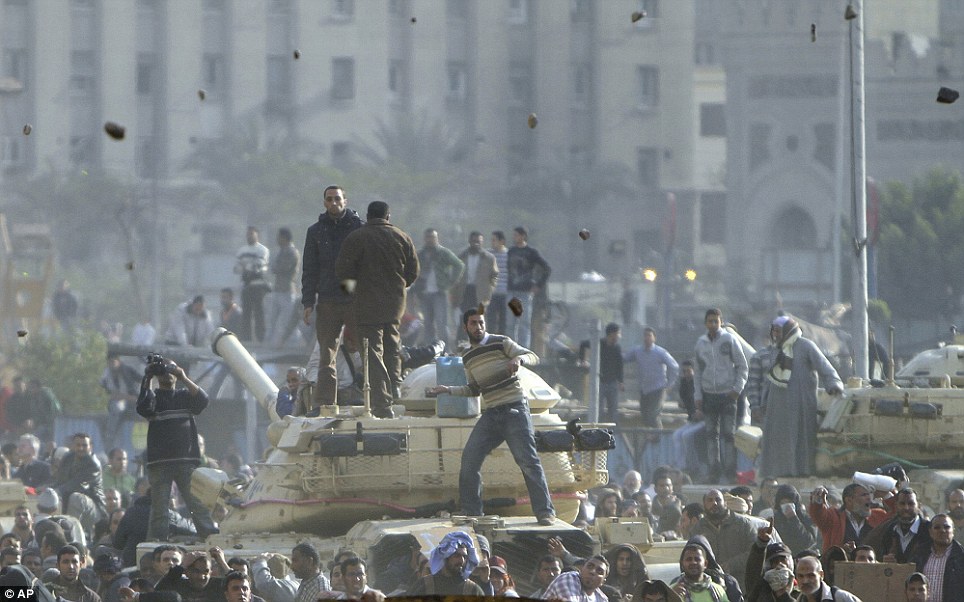
There were extraordinary scenes in the centre of Cairo as anti-government demonstrators fought running battles with organised cohorts of Mubarak supporters, exchanging blows with iron bars, sticks and rocks. At one point pro-Mubarak forces rode camels and horses into central Tahrir Square, scattering opponents. At least three people were killed yesterday and up to 1,500 injured according to medical sources. A palm tree and a building caught alight while fires were burning outside the historic Egyptian museum as petrol bombs were hurled back and forth between the two opposing factions. The violence was immediately condemned by David Cameron, the Obama administration, and Ban Ki-moon, the UN secretary-general, who condemned what he described as attacks on peaceful demonstrators. The White House warned that if any of the violence was instigated by the government it should stop immediately, and also strongly criticised the beating of local and foreign journalists, including a CNN reporter.

But after Mubarak’s announcement that he would not seek another term at elections due in September, the regime appeared to be in no mood to listen – and determined to regain control after a week of near anarchy. The strident tone was illustrated by a startling public rebuff to Barack Obama. Rejecting his overnight demand that the promised political transition and reforms begin without delay, the Egyptian foreign ministry said bluntly that meddling by “foreign parties” was unacceptable and was “aimed to incite the internal situation”. Guardian journalists in the square – close to both sides – witnessed pitched battles that turned the square into a warzone as anti-Mubarak protesters tried desperately to hold their ground and both sides tore up paving stones to use as weapons. Among those singled out for attack were journalists including Anderson Cooper of CNN and two Associated Press correspondents. A Belgian journalist – Maurice Sarfatti, who uses the byline Serge Dumont – was reportedly beaten, arrested and accused of spying.

Video of the Demonstrations before the Pro Mubarak attack

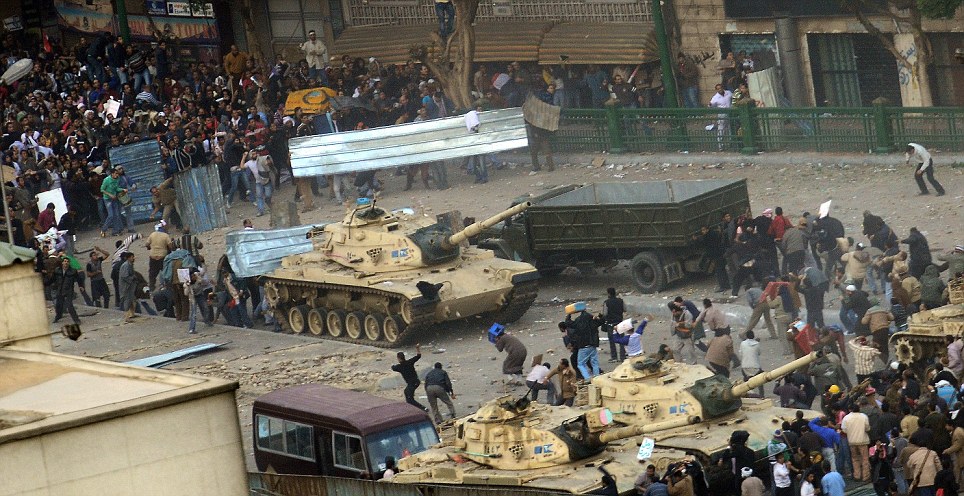
At one stage tanks attempted to move between the two groups but did little to stop the escalating clashes. In one incident soldiers moved out of the way to permit pro-Mubarak demonstrators to reach their opponents. By late afternoon, groups of men were on roofs in Champollion Street, a few hundred metres away, hurling missiles down on those beneath them. At just after six o’clock automatic weapons fire was heard. Some pro-Mubarak forces appeared to be plainclothes police, while others involved in the assault in Tahrir Square were said to have been paid by the regime. The interior ministry denied the reports, while the army denied firing on protesters. In other cities the regime fought back strongly. In Alexandria, Mubarak supporters staged a furious counterprotest in a square that has seen protests for nine days, sparking violent arguments and altercations between rival groups. The violence increased fears in western capitals that the crisis, far from being defused, was taking a more sinister turn. David Cameron said: “If it turns out that the regime in any way has been sponsoring or tolerating this violence, that would be completely and utterly unacceptable.”

Pro Mubarak thugs including Secret Police attacking peaceful demonstrators in Tahrir Square (Liberation Square)

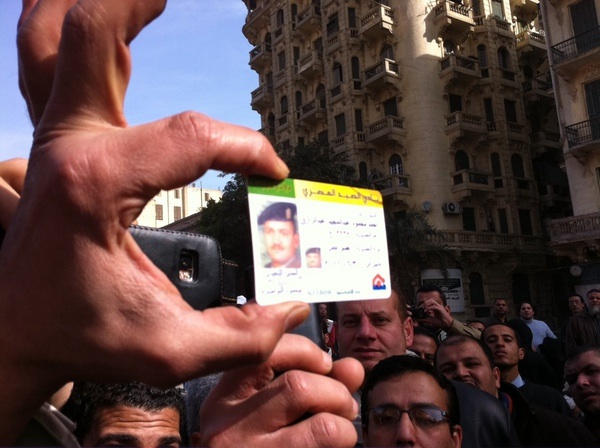
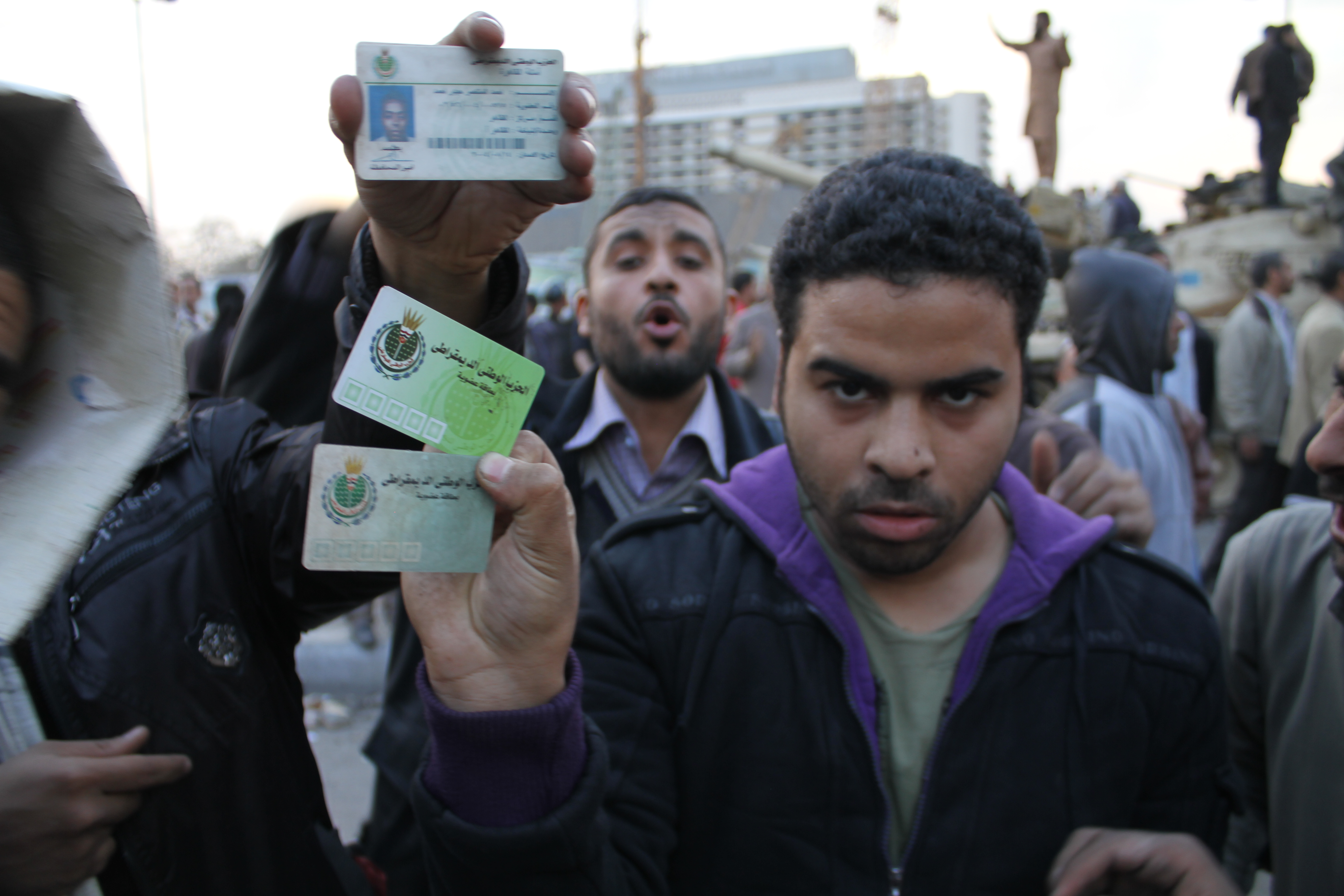
Government ID which was removed from the Pro Mubarak “Protestors” (Secret Police)

Thousands of supporters of President Hosni Mubarak today attacked anti-government protesters as fresh turmoil gripped Egypt. Backers of the president, who last night agreed to relinquish his grip on power, fought with the crowds in Cairo’s Tahrir (Liberation) Square, injuring more than 600 people. Some rode into the ranks on horses and camels while wielding whips. In chaotic scenes, they pelted each other with stones, large sticks and machetes. The death toll since protests began eight days ago is now thought to be as high as 300, according to Navi Pillay, the UN High Commissioner for Human Rights. Reports to the world body from nongovernmental sources in Egypt also suggest that more than 3,000 people have been injured. Many of those who demonstrated in support of the regime today are believed to be secret police in plain clothes. There were reports that concrete blocks has been hurled on pro-democracy protesters. The army has stood by and refused to intervene so far. But there are growing fears that there will be a massacre. Opposition leader Mohamed ElBarawi said that Mr Mubarak was using ‘scare tactics’ to stay in power.

‘I’m extremely concerned. My fear is that it will turn into a bloodbath,’ he said. The White House said the U.S. was ‘deeply concerned’ about the attacks on media and peaceful demonstrators.  The morning – the eighth day of protest – began peacefully enough with a fresh round of protests in Tahrir Square. But for the first time thousands of Mr Mubarak’s supporters descended on the massive public space, the scene of a yesterday’s 250,000 strong demonstration. Around 3,000 supporters of the 82-year-old leader were seen breaking through a human chain of anti-government protesters as they tried to defend the thousands gathered in the Square. Chaos erupted as they tore down banners denouncing the president and fistfights broke out as they advanced across the plaza. The two sides started hurling stones, bottles and sticks at each other and gave chase. At one point, some pro-Mubarak forces rushed in on horses and camels swinging whips and sticks. Protesters retaliated – dragging them from their horses and throwing them to the ground then beating them. People were seen running with their shirts and faces bloodied while some men and women in the crowd wept. Tear gas was believed to have been deployed, though it was not clear who had fired it. The demonstrations appeared to be the start of an attempt by Mr Mubarak’s three-million strong National Democratic Party to retake momentum from protesters demanding Egypt’s nearly 30-year ruler step down immediately. In a broadcast last night, he had promised to step down at elections in December. But his opponents say that this is simply not soon enough.

Egypt’s band of opposition parties, including the banned Muslim Brotherhood, have begun to coalesce around the figure of Mohamed El Baradei, a Nobel Peace laureate for his work as head of the UN nuclear agency. Yesterday in Cairo, effigies of Mr Mubarak were hung from lamp-posts, as people screamed for him to quit, likening him to Hitler and a donkey. Khaled Osman, 40, a tourist guide from Aswan, said: ‘I am so happy that the old man has finally given up. But he must go now. And we will stay here campaigning until he goes. ‘The game is over, he knows that.’ Tourist guide Mohammed Al Gawad, 33, from Hurghada, said: ‘We have had enough of his brutality. We want to be free. ‘We want to decide our own destiny. And we want jobs. These are the things that Mubarak has not given us. He just stole our money.’ Cairo’s international airport was a scene of chaos as thousands of foreigners sought to flee the unrest, and countries around the world scrambled to send in planes to fly their citizens out. Some tourists even reported being forced to pay bribes to policemen before being permitted to board what planes did manage to take off. An estimated 18,000 were still stuck there yesterday, although many British citizens and other holidaymakers in Sharm el Sheikh and the Red Sea resorts are staying put. Even having a ticket was no guarantee that tourists could get on a flight, it has emerged.

‘People holding tickets had difficulties getting on the plane, because the airport in Cairo is pure chaos,’ Canadian tourist Tristin Hutton said Tuesday after his plane landed at Germany’s Frankfurt airport. ‘The terminals are full of panicking people. The ground staff is disappearing, and at the gate, just before entering, we all together had to collect $2,000 for a policeman at the door… He would not let us pass without paying. Internet service also began returning to Egypt after days of an unprecedented cutoff by the government, and state TV said authorities were easing a nighttime curfew, which now runs from 5pm to 7am instead of 3pm to 8am. The various protesters have little in common beyond the demand that Mubarak go. Perhaps the most significant tensions among them is between young secular activists and the Muslim Brotherhood, which wants to form an Islamist state in the Arab world’s largest nation.
The more secular are deeply suspicious as the Brotherhood aims to co-opt what they contend is a spontaneous, popular movement. American officials have suggested they have similar fears. The outlawed Muslim Brotherhood remains Egypt’s largest opposition movement. In a nod to the suspicions, Brotherhood figures insist they are not seeking a leadership role. ‘We don’t want to harm this revolution,’ Mohamed Mahdi Akef, a former leader of the group.

Egypt crisis: Mubarak supporters on horseback attack anti-government protesters

In chaotic scenes, the two sides pelted each other with stones, and protesters dragged attackers off their horses. This is the first significant violence between supporters of the two camps in more than a week of anti-government protests. It erupted after President Mubarak went on national television on Tuesday night and rejected demands he step down immediately and said he would serve out the remaining seven months of his term. On Wednesday morning, a military spokesman appeared on state television and asked the protesters to disperse so life in Egypt could get back to normal. The announcement could mark a major turn in the attitude of the army, which for the past two days has allowed protests to swell, reaching their largest size yet on Tuesday when a quarter-million peace packed into Cairo’s central Tahrir Square. Nearly 10,000 protesters massed again in the square on Wednesday morning, rejecting President Mubarak’s speech as too little too late and renewed their demands he leave immediately. In the early afternoon, an Associated Press reporter saw around 3,000 Mubarak supporters break through a human chain of anti-government protesters trying to defend thousands gathered in Tahrir.

Chaos erupted as they tore down banners denouncing the president. Fist fights broke out as they advanced across the massive square in the heart of the capital. The anti-government protesters grabbed Mubarak posters from the hands of the supporters and ripped them. The two sides began hurling stones and bottles and sticks at each other, chasing each other as the protesters’ human chains moved back to try to shield the larger mass of demonstrators at the plaza’s centre. At one point, a small contingent of pro-Mubarak forces on horseback and camels rushed into the anti-Mubarak crowds, swinging whips and sticks to beat people.

Protesters retaliated, dragging some from their mounts, throwing them to the ground and beating their faces bloody. Protesters were seen running with their shirts or faces bloodied, some men and women in the crowd were weeping. A scent of tear gas wafted over the area, but it was not clear who had fired it. The army troops who have been guarding the square had been keeping the two sides apart earlier in the day, but when the clashes erupted they did not intervene. Most took shelter behind or inside the armoured vehicles and tanks stationed at the entrances to Tahrir.