Category Archives: Main

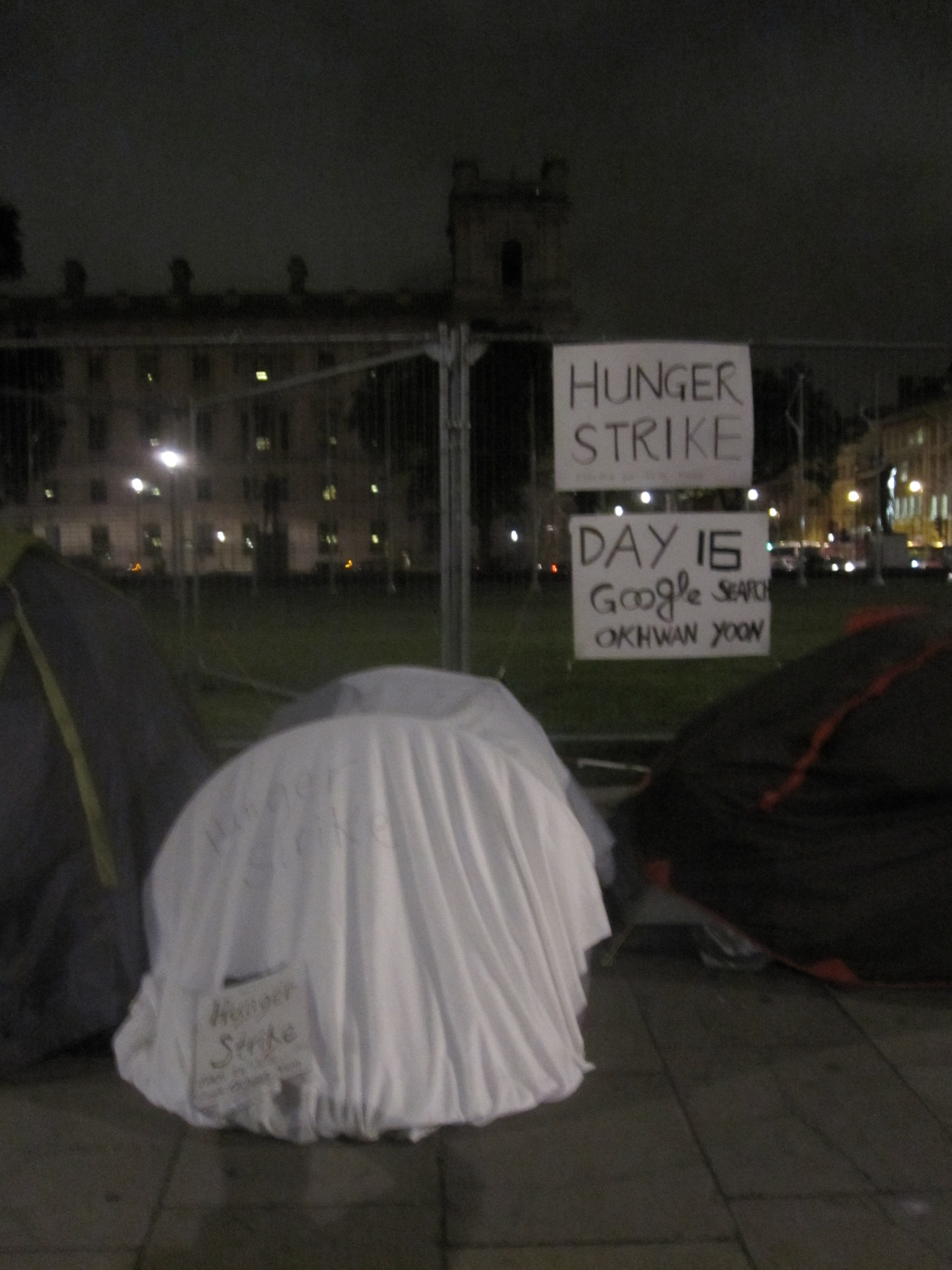
Okhwan Yoon on Hunger Strike – Parliament Square – (Day 20)

July 15, 2011 (Day 19) - Parliament Square, London, UK

July 4, 2011

The Super Cool Bike Shop (Florida)

Okhwan Yoon

Today we got a very interesting visit from Okhwan Yoon, a man cycling around the world. He was passing through town on his Trek road bike and happened upon one of our regulars, who brought him by the shop. A very nice soft spoken man, with a hell of a story. Here is a article written on him by a San Diego newspaper.

http://www.supercoolbikeshop.com/

No detour around danger for globe-gliding cyclist

October 17, 2008

Okhwan Yoon departed South Korea seven years ago with his bike, yearning to see the world and discover why it’s so violent. His education thus far: Yoon has been struck six times by cars, kidnapped in Sudan, held up in Portugal, attacked by knife twice and robbed of cameras five times. Despite the frightening experiences, he pedals on. “I am not scared of death,” said Yoon, 46, who arrived in San Diego on Saturday and planned to depart for Los Angeles yesterday. “But I am scared of stopping this odyssey.” To date, Yoon said he has visited 169 countries. He plans to travel three more years, hoping to reach 195 nations.

Staying in youth hostels, motels and sometimes sleeping outside (spending a night in downtown San Diego beneath a table), Yoon said he has paid for the trip himself. He said he owned a clothing trading company for three years in South Korea, saved for the trip, earned $3,000 during his journey giving speeches and has received assistance along the way. After graduating from college with a law degree and battling chronic illnesses, Yoon remembers sitting at home, watching TV. Traffic, kidnappings, murder, robbery and suicide filled the news. “Why is the world so noisy?” he asked himself.

So off he embarked in search of answers. At times he’s cycled 150 miles a day, Yoon said. Of his past illnesses, “all that has been lost since going through this journey.” Africa holds some of his fondest memories. He was moved to tears watching sunsets as soul music played in the background. The music didn’t emanate from anyone playing instruments. Instead, it was in Yoon’s mind, lodged there from listening to local music on the radio. About watching the sun dip into the horizon, Yoon said, “It was like the last moment of one’s life, like when a leaf falls.”

In African villages, he remembers people hauling heavy bowls of water for miles. “Water is precious,” Yoon said. “It helps them make food. Yet when I would ask for water, they would provide water without complaining. With smiles.” He calls Africa “the original soul of the world, friendly and hospitable.” But his experience in war-torn Sudan was not so warm. He said two rebel soldiers aimed rifles at him in a town, forcing him to walk to a compound in bush country. By about 2 a.m., sitting outside a tent, Yoon said the men assigned to guard him were drunk and had fallen asleep, enabling him to escape with his bike.

The knife attacks, he said, came in the Republic of Suriname, a small South American country bordering Brazil, and recently in Phoenix. In Phoenix, Yoon said he used his bike to block a young man’s lunging knife thrusts. The man eventually ran away with Yoon’s bike. Yoon said he ran the man down, kicked him in the back and saved his bike. “I hate fighting,” said Yoon, who is 6 feet tall and weighs 150 pounds. “(But) if somebody feels dangerous (to me), I show them taekwondo positions, and mostly they gave up on me.” Other Yoon impressions of places and people he visited: The United States: “The very same feeling when I was in England. They respect privacy and individualism.” That, though, he said casts a feeling of “a lack of humanity.”

Mexico: “Many people liked to talk to me.” Brazil: “The best fruits and vegetables. They treat me like a friend.” France: “A furnace of ethnicities. Whites, Hispanics, blacks, Christians. They live together harmoniously.” San Diego: “Peaceful, comfortable,” based in part because, like South Korea, the city is bordered by the Pacific. Yoon is working on his fifth bike, estimating they’ve cost$20,000. Not wanting to attract attention to himself, he usually takes a saw or a nail and defaces the bike frames, making them look old and battered. Despite intentionally damaging the bikes, Yoon said they have become his friends.

“Like my partner, like my soul mate,” he said. “Sometimes I feel like we talk to each other. In the jungle or desert, it gives me a lot of encouragement.” Media outlets in Micronesia, Pakistan, Canada, Samoa, Mexico and El Paso, Texas, have carried stories about Yoon. In San Diego, he asked if a reporter had contacts with a publishing company because he thinks his story is worthy of a book. Others, he said, told him it should be made into a movie. He said his travels have left him feeling like a modern-day explorer.

“Like Columbus, Magellan or Vasco da Gama,” he said. A deep thinker who said he speaks seven languages, Yoon also possesses a childlike wonder. For example, he hopes to meet Gov. Arnold Schwarzenegger. “In Korea, he’s the symbol of the Terminator,” Yoon said. “He’s a very strong character, like Spiderman or Batman. He can save the world.” As for world peace, Yoon is not optimistic. “I think that is not possible,” he said. “Every human being possesses instincts. The yin and the yang. The shadow and the light. We need to care for each other as family. “But mostly people think about my country, my society. People are too materialistic, too selfish.”

Stop the War Protest – July 12

Anti-War Mass Assembly 10 Years On Occupy Trafalgar Square London Saturday 8 October Protest Bring the troops home Stop the bombing

Adhaf Soueif, John Pilger, Tariq Ali, Brian Eno, Jemima Khan, Tony Benn, George Galloway, Caroline Lucas MP, and many more, will be in Trafalgar Square on Saturday 8 October at the anti-war mass assembly on the tenth anniversary of the invasion of Afghanistan.

The last ten years of war have been catastrophic. Tens of thousands killed in Afghanistan. A million killed in Iraq. Pakistan is on the brink of collapse. More than 550 British soldiers dead and now civilian casualities in Libya, the third western war on a Muslim country. The killing goes on. As politicians insist on deep cuts to essential public services, Britain is spending £5 billion a year on the war in Afghanistan, and will have spent £1 billion on Libya by the Autumn.

Armed forces veterans, school students, musicians, trade unionists, writers, artists, academics, politicians, campaigners, and military families, will occupy Trafalgar Square on Saturday 8 October to show our opposition to war, representing the vast majorty of people in Britain who have opposed Britain’s involvement in Afghanistan, Iraq and Libya. There will be music, film shows, performance events, art installations, and much more. We are also planning a series of rallies around the country and major cultural events in London in the run up to the mass assembly.

Join us in Trafalgar Square. Sign the pledge to be there: http://antiwarassembly.org  – Facebook Event Click Here

http://stopwar.org.uk

Okhwan Yoon on Hunger Strike – Parliament Square UK

Tuesday, July 12, 2011

Korean on Hunger Strike for Peace at Parliament Sq

July 12, 2011

Okwhan Yoon is from South Korea. He recently arived at Parliament Square and started his hunger strike on 26th June 2011. He has been on a ten year, global cycling tour, in order to inspire and  promote the message of peace. Okwhan is now on day16 of his strike, demanding  freedom for  North Korea and the opening of the border with South Korea bring with it democracy for the people!

60 years of isolation and oppression has now past and the time has come for the  people to make a peaceful stand for change. As you will appreciate, being a cyclist, his body weight is minimal, and so the hunger strike will take its toll on him quciker than a person with greater body mass. He is a gentleman, quiet and thoughtful. He is also determined with a strong mental focus. A press release has been sent out. Also the All party group for both North and South Korea have been notified that he is at the square. We encourage people to support him in his great struggle. He is sincere in his effort.

https://london.indymedia.org.uk/articles/9548

Video time frame: 04:50

My Dream

“I have a dream that one day there will be a united Korea and a united world. North and South Korea represent the last country that is divided by ideology. When Korea is finally reunited it will be a great step towards world peace. I’m convinced that the meaning of the world peace is to understand and respect each others: ideology, culture, religion, language, and identity. Understanding one another forms a deep connection from heart to heart, society to society, and boarder to boarder.

I wish to witness a united Korean peninsula in my lifetime with all my dear friends throughout the world. With strong support my dream of uniting Korea can come true. We have faced great challenges this generation but it is our duty to help raise our children in a more peaceful world. Face to face, hand to hand, shoulder to shoulder, side by side we can defeat this hatred and make our only world beautiful.”

http://okhwanstory.blogspot.com

June 11, 2010

AMMAN – Very few people would choose to become homeless and wander around the globe. But then again, very few people are like South Korean cyclist Okhwan Yoon. The 48-year-old told The Jordan Times that a passion for peace, patience, guts and discovery has taken him across six continents in a quest to spread his message in every country in the world on two wheels. “I suffered from chronic illnesses during my early life,” Yoon said noting that shortly after enrolling in the Chung-Ang University in Seoul, he reached the “peak” of his series of non-stop illnesses. Battling hepatitis B, asthma and allergies, he thought he was in “the final stage of life”.

But his outlook on life was changed forever when as a university student he “was jailed and tortured for participating in protests against the military regime”. “After I graduated, I wanted to enlighten my- self by learning different cultures to understand why the world is full of wars, murders and suicides,” said the peace activist, who arrived earlier this month in Jordan, the 186th country on his worldwide tour. He decided the best way to learn about the world was to experience it himself, and chose to make the journey by bike as it is “the cheapest way of travelling and the most physically demanding”. He set off in 2001, riding to China on a bicycle. As his quest gained steam, he picked up sponsorship from friends, business owners and universities around the world in order to pay for his expenses.

Yoon, who came to Amman from Syria, said he wants to open the world’s eyes to the importance of peace and tolerance by reminding each nation of the need to choose love and harmony over conflict, riots and war. Over the years of touring the US, Europe, Asia, Africa and the Middle East, it has not all been clear sailing for Yoon. He bears scars from attacks and kidnappings and has been struck by cars and involved in near-fatal accidents. The cyclist has also been robbed of his cameras and diaries several times. “I was kidnapped in South Sudan by rebel soldiers in 2004 and kidnapped four times in Africa,” Yoon highlighted. But the cyclist said he also has good memories from every nation he visited, adding that his length of stay in each country depends mostly on its size and variety.

“Each country has its own flavourة for example I loved the exotic fruits and vegetables in Brazil, relished the cultural diversity in France and am enjoying the company of good people in Jordan,” Yoon indicated, adding that he will stay in the Kingdom until he receives a visa to visit Saudi Arabia. He said he will remain on the road until he reaches his goal of 192 nations, after which he plans to return to South Korea, write a book on his adventures and become a politician. Travelling with little more than his bike and a backpack, the 48-year-old said he sometimes feel nostalgic for his homeland and yearns for stability.

“I sometimes cry alone, longing for my country and family… but I have sacrificed too much to end it now,” said Yoon, who confessed that he is still driven by the urge to travel. “I am addicted to travelling and meeting new people. This is bigger than a normal life,” he said. The final countries on his itinerary are Bhutan, Nepal, Saudi Arabia, the Maldives and several island nations, according to the peace activist.

The Cycle Diaries

September 25, 2008

In January, the British traveler Mark Boyle set off from his home in England to embark upon a hike across two continents all the way to India. He got as far as France. Northern France. Okhwan Yoon, from Seoul, South Korea has made it a little further. Setting off in 2001, he has cycled thousands of miles across Asia, Africa, Europe and the Americas. A few days ago he entered his 169th country – the United States, crossing the border at Juarez into El Paso.

I caught up with Yoon, 46, at the Bicycle Company on North Mesa this morning. A man of slender build, he speaks charmingly broken English and has been extended a warm greeting by the local Korean community in town. “I want to experience different cultures,” he tells me as he surveys the damage his exertions have wrought on his bike. But his interest in other cultures goes beyond casual interest. In May 2007, cycling through his 133rd country, he told Samoan reporters he travelled “to proclaim world peace.” Earlier this year he shared his slogan with TV crews in El Salvador: “one Korea, one World.” He elaborated this morning upon his hopes for world peace, his wish to work for an international organization and his plans to document his travels in an autobiography.

But these ambitions have come at a price for the lonely cyclist. He has slept rough, been robbed and has labored through war zones (including Afghanistan). Saudi Arabia and Libya refused him visas. Most amazingly he was kidnapped in the Sudan only to escape several days later. But Yoon is philosophical about his experiences. “Whether good or bad, everyday [I] try to cultivate my soul,” he explains with an eerie simplicity. Such an attitude is obviously prerequisite to his perseverance. So far Yoon has been in six car accidents. The last of these left him in hospital for two weeks. His response has always been to dust himself off (and get his stitches removed) before cycling onward.

Presently he plans to cycle to Los Angeles before flying to country number 170: the Bahamas. He intends (visas pending) to travel to a further 35 countries over the next three years before returning to Korea and settling down (and presumably investing in new legs). Before we finished I asked him about his hopes for the future. “No more car accidents please,” he replied with both a frown and a smile. As someone about to cycle across New Mexico, this seems rather idealistic.

Yahoo News

South Korean cyclist Okhwan Yoon, a contributor of the film, Life in a Day, arrives for its UK premiere at Westfield Shopping Centre, west London, Tuesday, June 14, 2011. The film is a user-generated feature-length documentary film, shot on a single day – July 24, 2010. It began as a historic global film experiment that enlisted the You Tube community to capture a moment of their lives on camera. Worldwide YouTube users responded with over 80,000 submissions from 192 countries, totaling over 4,500 hours of footage. Having cycled through 191 countries, Westfield Shopping Centre management, however, would not allow Yoon to cycle in the centre for a photo. (AP Photo/Joel Ryan)

International Cyclist, Okhwan Yoon visits The Bahamas

Mar 17, 2009

Grand Bahama Island – International cyclist, Okhwan Yoon of Seoul, South Korea visited The Bahamas via Grand Bahama Island as his 171st country on his world tour. Yoon set out in 2001 to find a place in the Guiness Book of World Records, but also more importantly, to make connections all around the world in an effort to encourage world peace. Upon arrival via a Discovery Cruise Line day trip, Yoon was presented with a welcome souvenir by the Ministry of Tourism & Aviation as a token of our appreciation for him having visited as well as our best wishes to him on his continued effort to make global connections.

Anti Cuts protest and Strike Day – June 29 – 30

Click to Continue

Continue reading

Parliament Square – June 18 – “Not doing very well here Steve”

Guantanamo Bay message for Obama’s visit

May 25, 2011

June 3, 2007 – November 16, 2008

Jan 22, 2009

March 9, 2011

The Right to Film in Public


Met Police clarifies public photography guidelines

April 22, 2010

More than nine months after first publishing “flawed” guidelines on photography and the use of anti-terrorism powers, the Metropolitan Police has clarified its policies adding, for the first time, that police officers have no right to delete or destroy images. On 09 July 2009, the Metropolitan Police issued a series of guidelines for its police officers that highlighted the rights of photographers when stopped by police forces in the streets of London. But, less than 24 hours later, the guidelines were deemed flawed by a media law expert speaking to BJP.

While the Metropolitan Police’s guidance made it clear that public photography was legal and shouldn’t be restricted with the use of anti-terrorism legislation such as the Terrorism Act 2000, the guidelines did not point out that police officers have no right to delete or to ask a photographer to delete images. Speaking to BJP back in July, Rupert Grey of media law firm Swan Turton, said: “Nowhere is it stated that officers do not have power to delete images or confiscate data cards without a court order. It is not enough just to say that they have the power to seize and retain articles on the basis of reasonable suspicion.’

The new guidelines now state: “Officers do not have the power to delete digital images or destroy film at any point during a search. Deletion or destruction may only take place following seizure if there is a lawful power (such as a court order) that permits such deletion or destruction.”

Photography advice

“Members of the public and the media do not need a permit to film or photograph in public places and police have no power to stop them filming or photographing incidents or police personnel.”

“If someone distressed or bereaved asks the police to stop the media recording them, the request can be passed on to the media, but not enforced.”

ΑΓΑΝΑΚΤΙΣΜΕΝΟΙ – INDIGNADOS – INDIGNANTS – Greek Solidarity Protest – June 12

Continue reading

Parliament Square – June 2011

Dr David Kelly death mystery deepens

Mystery of the helicopter that landed at scene of Dr Kelly’s death after his body was found

May 14, 2011

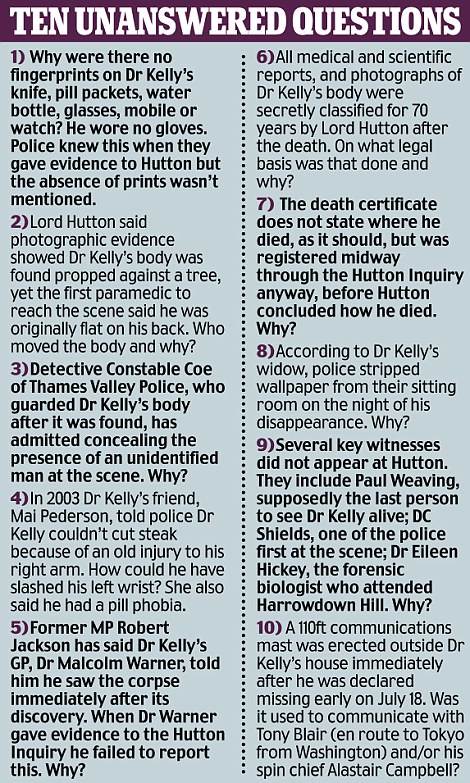
A helicopter mysteriously landed at the scene of Dr David Kelly’s death shortly after the body was found. The aircraft only remained on the ground for five minutes before leaving, suggesting it either deposited or collected somebody or something. Details from its flight log, released under the Freedom of Information Act, show that the helicopter – hired by Thames Valley police – landed at Harrowdown Hill in Oxfordshire at 10.55am on July 18, 2003, 90 minutes after the body was discovered by volunteer search teams. Significantly, the flight log has been heavily redacted, making it impossible to know who was on board or what its exact purpose was.

http://www.youtube.com/watch?v=Gx1vgcLDLWA%5D

The flight was not mentioned in oral evidence at the Hutton Inquiry, set up by Tony Blair to investigate Dr Kelly’s death. Dr Andrew Watt, who has previously raised questions about the suicide finding reached by Lord Hutton, has written to Attorney General Dominic Grieve drawing his attention to the flight. Dr Watt, a clinical pharmacologist, said: ‘If the purpose of the helicopter flight was innocent, one has to ask why it was kept secret.’ The riddle joins the growing list of unanswered questions about the circumstances of the government weapons inspector’s final moments.

It emerges in the same week that Tony Blair and Alastair Campbell were accused of lying to the Chilcot Inquiry into the lead-up to the Iraq war. The Mail reported yesterday how declassified documents from the inquiry revealed a spy chief disputed Campbell’s claim that the dossier was ‘not the case for war’. A senior diplomat also accused the former prime minister of distorting expert reports about the post-war chaos. Dr Kelly is said to have killed himself in woods near his home after being named as the prime source of a BBC report accusing the Labour government of lying to take Britain into war in Iraq.

Inquest into weapons inspector Dr David Kelly’s death ruled out

June 10, 2011

The Attorney General said there was “no evidence” of murder. Dismissing claims of a “cover-up”, Dominic Grieve ruled out asking the High Court to order a hearing, saying the evidence that Dr Kelly committed suicide was “overwhelming”. The government scientist’s body was found in woods close to his Oxfordshire home in 2003 – shortly after he had been revealed as the source of a BBC report questioning the accuracy of the then Labour Government’s dossier arguing the case for war in Iraq. The Hutton Inquiry in 2004 concluded he had killed himself by cutting a wrist and the then Justice Secretary Lord Falconer ruled the inquiry could take the place of a coroner’s inquest.

A group of campaigning doctors claim the evidence does not point to suicide. But Mr Grieve told MPs yesterday: “I’ve concluded that the evidence that Dr Kelly took his own life is overwhelmingly strong. “Further, there is nothing I’ve seen that supports any allegation that Dr Kelly was murdered or that his death was the subject of any kind of conspiracy or cover up.” The group of doctors, led by Dr Stephen Frost, declared they would seek a judicial review of the Attorney General’s decision. Dr Frost commented after the ruling: “This Government has now revealed itself to be complicit in a determined and concerted cover-up.

“Four successive governments have sought to obscure the truth of what happened. The cover-up could not be more obvious.” PM David Cameron also suggested last month a full inquest was not needed, saying the Hutton report had been “fairly clear”. And Labour’s Shadow Solicitor General Catherine McKinnell yesterday backed the Government’s position, agreeing that there was a “lack of new compelling evidence” that Dr Kelly had not committed suicide.