Category Archives: Main

US Patriot Act Vote 2011

House of Representatives

House votes to extend Patriot Act surveillance powers

The US House of Representatives has agreed to extend some of surveillance powers granted by the 2001 Patriot Act after the 9/11 attacks. In a 275-144 vote, the chamber voted to extend until December provisions on wiretaps, access to business records and surveillance of terror suspects. The White House backed the bill, but would have favoured a longer extension. The bill failed a vote last week, when it was brought to the floor under rules requiring a two-thirds majority. The matter now goes to the Senate for its consideration. The provisions are set to expire on 28 February.

Senate

Senate votes to extend provisions of Patriot Act

WASHINGTON – The Senate has voted to extend roving wiretap authority and other provisions of anti-terrorism law for 90 days, giving lawmakers more time to discuss the future of the law enforcement tools that some consider an infringement on civil liberties. The Senate vote to extend three terrorism-fighting tools for three months comes a day after the House approved an extension until Dec. 8. The two chambers must now agree on a common time period before the three USA Patriot Act-related provisions expire on Feb. 28. In addition to roving wiretaps for multiple electronic devices, the provisions deal with court-approved access to business records and surveillance of non-U.S. “lone wolf” suspects without known ties to terrorist groups. Senate Democrats are working on a multi-year extension plan that tightens oversight of the measures.

Argentina’s Economic Model?

Argentine workers take control

The workers of the San Justo glassworks in Buenos Aires never thought about owning their company, until it went bankrupt four years ago. It was just one of thousands of businesses that sank as Argentina’s once prosperous economy went into meltdown, pushing almost half the population below the poverty line. Today a new furnace where the red hot glass is melted is burning. The factory is one of more than 100 “recovered businesses” which are now putting themselves forward as an alternative business model for the country. When the factory went bankrupt, a group of the workers faced with losing their jobs barricaded the factory gates for almost a year to stop the machinery being taken away.

They slept under canvas through the worst of the winter, while a lawyer argued their case in court. The hardest thing was that many of their families, who did not have enough to eat, did not support the venture. “We had to fight with our families, who did not believe in this. They would tell us to go find a job,” says Leonicio Eloy Arias, who has worked at the factory for more than 20 years. The workers claimed in court that because they had not been paid for months, they should have first right to the machinery and factory site. Eventually, a judge gave them permission to restart the furnaces. Today the 38 workers at the glassworks are once again making glass car headlights, exporting these as spare parts to other countries in South America.

They have managed to make enough profit to reinvest some of it in new machinery. And they earn about $500 a month, a good wage for Argentina and one that equals the best period when the factory was in private hands. Since the workers took over, the shipyard has had little business, because it still does not have legal recognition to the land, making it difficult to get long term orders. The workers survive from refitting riverboats. But for them it is profitable. “Because workers need only something to take home, normal economic theory does not apply,” says Luis Caro, the lawyer who represents the movement.

Everyone in the recovered businesses gets paid the same, and decisions are taken through meetings of all the members. “Internal agreement is the key to success,” he says.  Luis Caro has written a new bankruptcy law, now going through Argentina’s congress, which would make it much easier for workers to take over factories that go bankrupt.  It has already been passed by the lower house and is awaiting approval by the senate. If the law passes Luis Caro says he hopes many more of the factories closed down during the crisis may be reopened.

Factories without Bosses: Argentina’s Experience with Worker-Run Enterprises

Peter Ranis

Only in community with others has each individual the means of cultivating his gifts in all directions; only in the community, therefore, is personal freedom possible. In the previous substitutes for the community, in the State, etc., personal freedom has existed only for the individuals who developed within the relationships of the ruling class, and only insofar as they were individuals of this class. The illusory community in which individuals have up till now combined, always took on an independent existence in relation to them, and was at the same time, since it was the combination of one class over against another, not only a completely illusory community, but a new fetter as well. In the real community the individuals obtain their freedom in and through their association. ~ Karl Marx, “The German Ideology”

Clothing and Ceramic Factory Workers Confront the Owners

“It was just a question of adding and subtracting. We can do that.” This was the response of a woman worker of one of the recently occupied factories of Argentina, the Brukman garment factory, as she explained why the workers were able to run the factory without their former managers or owners.1 Brukman is just one example of the many factories and enterprises taken over and run by their workers and employees since the late 1990s; their number has multiplied substantially since the Argentine economic crisis of 2001. The Brukman takeover became one of the more celebrated confrontations between the workers, most of whom were female, and their employers and the Argentine state. The factory takeover occurred on the eve of the historic outbreak of popular discontent on December 19 and 20, 2001. The factory was located in center of the capital city of Buenos Aires and thus received intense media attention.

After several failed attempts to oust the workers, the many community piquetero (unemployed, poor workers), and political activists (students, intellectuals, Madres de la Plaza de Mayo, human rights groups, etc.) who kept vigil around the clock, the police finally occupied and closed the factory on behalf of the former owners during a surprise raid the day before Easter in April 2003. Several days later the workers failed in an attempt to retake the factory on a day that was marked by major violent confrontations between them and their thousands of supporters and more than a thousand police officers. After the expulsion, the workers and their supporters maintained their presence and their protests in tents near the factory entrance while they petitioned the Buenos Aires municipality to expropriate the Brukman garment factory on behalf of the workers.

At this point counter litigation procedures began with the workers asserting their demand to continue to produce men’s suits and to receive back the lost wages from many years of arbitrary salary reductions, while the Brukman owners called for a return of their property that they had previously decapitalized and downsized over several years.2 Luis Zanón, the owner of the largest ceramic tile factory in Argentina, located in the city of Neuquén, in the western province of the same name, attempted to close down his factory and lock out his workers in October 2001. Luis Zanón, after receiving loans and credits of US$45 million from the World Bank, Banco Rio, and the Neuquén Province, decided to liquidate the plant and sell it off after years of firing workers and other cost-cutting measures, such as dangerous speed-ups that had cost the life of one worker and injuries to countless others. At the time of its closing, in October 2001, factory production had fallen to 20,000 square meters of tile per month as Zanón used his capital for speculative and personal investments divorced from the needs of his factory.

With the worker takeover in early 2002, Zanón became the symbol throughout Argentina of opposition to neoliberal governmental collusion with corporate finance. Governor Jorge Sobisch supported the former owner and saw the factory shutdown and worker takeover not as increasing provincial unemployment but as a working class virus that had to be crushed. Given that Neuquén province was home to the newly privatized gas and petroleum holdings, employing over 15,000 workers, the Zanón worker experiment represented a dangerous alternative model. Zanón is one of the few cases in Argentina where the workers began production without the legal permission of the bankruptcy court judge or a provincial legislature to form a workers’ cooperative.

Victimized Workers

The attempted factory lockouts were opened to Argentine enterprises by the labor legislation passed during the two presidential administrations of Carlos Menem (1989 – 99). Under the peso-dollar convertibility law, transnational capital increased its domination over the Argentine industrial economy as small and medium-sized enterprises found it much harder to compete. Under the aegis of an overvalued dollar/peso parity, foreign investment increased significantly, as did foreign imports of all kinds of industrial products. While we witness a spiral of Argentine deindustrialization, investments abound in the utilities, services, and extractive economies. The demise of industrialization had a nefarious effect on domestic enterprises with a concomitant increase of unemployment, poverty, and inequality increasingly symptomatic of a dual society.3 The partial financial default of Argentina in late 2001 sharpened these
conditions. The collapse of the peso convertibility severely affected smaller firms with higher levels of indebtedness, those that produced for the domestic market but often depended upon imported raw materials and supplies for their production.

The reasons behind the collapse of many small and medium-sized Argentine industrial firms are complex. There is little doubt that the crisis accentuated preexisting patterns and behaviors among the owners of these companies. Almost all started proceedings that would end in default to their creditors and outright declarations of bankruptcy. Under the Menem Employment Law of 1991, firms were allowed to approach the Ministry of Labor under “crisis-prevention procedures.” Under its provisions a firm could petition to subcontract and/or use some of its workers outside collective-bargaining agreements and in other than full-time employment. It also allowed a firm to lay off or fire a number of workers in order to avoid bankruptcy, which would result in even higher levels of unemployment.4 In 1995, a “flexibilization”
law was passed that had huge repercussions.

Aimed at enterprises with forty or fewer employees, businesses that employ approximately four out of five Argentine workers, it allowed the owners of these firms to reconfigure the workplace to enhance productivity and to restructure their workforce based on technological, organizational, and market rationales. Thus many of the bankruptcies were related to the economic crisis accentuated by the advent of the severe recession of the late 1990s. However, invariably in the cases in which workers chose to occupy their factories and enterprises, there was overriding evidence that the industrial recession was often fraudulently used by the owners to decapitalize their firms, to attain governmental credits for non-production-related financial speculation, and, ultimately, to deprive the workers of their earned wages.5 As one observer wrote, “without secret, dirty, and unpunished monet accounts, there would be no recuperated factories.”

Brukman and Zanón under Worker Control

Quite typical of these many smaller Argentine companies, Brukman had begun laying off workers in 1995 to supposedly prevent closing altogether, which was allowed by labor legislation passed in that year under the Carlos Menem presidency. The workers who remained had their pay packages reduced from 100 pesos a week to 90, 80, 70, and eventually to 2 pesos at the time of the 2001 takeover! At the same time, the Brukman owners received loans privately and from the government to keep their factory afloat. As in numerous other cases, lawyers on behalf of the workers found that the loans were used for financial speculation both within Argentina and abroad. In October 2003, the municipality granted a temporary expropriation and allowed the sixty or so remaining workers to return to the Brukman factory by December of 2003. The workers and their legal counsels, along with twelve other city factories
and enterprises, continued to press for a law of permanent expropriation, which was finally granted by the Buenos Aires Municipal Council in November 2004.

Before the seizure of the factory, the remaining workforce had managed to continue to manufacture and market men’s suits despite difficult conditions, such as the loss of some of the machinery and investment capital and the challenge of reestablishing contacts with providers and retailers. Although not all the workers were willing to confront their former bosses, the majority remained and established a modicum of the previous production. As one of the workers explained, “We already know how much a suit costs, how much the raw materials cost. Perhaps this is why they want to throw us out, because we know how to manage a factory, and we know that if workers can run a factory they can also run a country and that is what the owners of businesses fear.”9 The workers of Zanón held a march and rally on July 7, 2005, to reaffirm their right to continue to occupy and recuperate their factory after four years of struggle resulting from the owner’s lockout in 2001.

The march was indicative of the wide community support for the tile workers in the city of Neuquén and included not only the tile workers but also health workers, public employees, teachers, professors and students, townspeople, and organizations of the unemployed (“piqueteros”). They called for the recognition of the right of Zanon’s workers to establish a cooperative, called “Fábrica sin Patrones” (“Factory without Bosses”) or FaSinPat in short. Several weeks earlier, a bankruptcy court judge had reopened bids to place the factory in private, capitalist hands once again. A bid by the wife and son of the former owner was disallowed by a Buenos Aires appellate court on August 5, 2005. This opened the way for the Zanón workers to establish a workers’ cooperative. Nevertheless, the Zanón workers’ ultimate aim remains state ownership of the tile factory under worker control.

By August 2005, Zanón had increased employment to 480 workers and production to 300,000 square meters per month. Of the 380 workers at the time of closing, 240 remained to occupy the factory and in February 2002 began production under worker control. Though political conditions under President Néstor Kirchner made expropriation of the plant without payment and under worker control an unlikely outcome, the workers continued to defend that vision. Distinct from the many Argentine labor unions that have not supported worker cooperatives, the Zanón Ceramic Workers local won control in 1998 against the former bureaucratic union that was in collusion with the owner. Once representing the workers, they have been instrumental in confronting a ever-more repressive factory administration. Since the attempt to shut down the factory in 2001, the union has successfully carryied out a democratically run factory with impressive outreach to the Neuquén community.

They hire from among the unemployed “piqueteros,” they built and have maintained a major neighborhood health clinic, and the factory has continually opened its doors to cultural, artistic, and sporting events. All decisions are made by majoritarian decisions of weekly-run worker assemblies. No leadership position is permanent, and the constant rotation of positions of responsibility is a hallmark of this cooperative. Every worker, whether in production, sales, or administration, earns exactly the same monthly salary. The Zanón workers see their factory at the service of their community and not the market, and that attitude has been translated into countless acts, and they have been compensated by the community in five attempts by the provincial police to take over the factory. Zanón workers are battling not just to be a workers’ cooperative factory but, also, an incipient movement inspiring social change.

Worker self-management in historical perspective, 1950-2006

A brief history of the movement for workers’ self-management in the 20th and 21st centuries. Examines instances of workers’ control in Yugoslavia, Chile, Bolivia, Peru and contemporary Argentina.

Introduction
Worker self-management (WSM) has re-emerged as a major movement in Argentina, particularly this year with over 200 factories organized and controlled by their workers and a national co-coordinator of self-managed enterprises in the process of being organized.

Historically, WSM has been the centerpiece of the socialist project, dating back to Karl Marx’s famous statement that the “workers’ emancipation can only be accomplished by the workers themselves”. In that sense, WSM as the road to socialism stands in contrast to the bureaucratic centralism of the former Soviet Union and the hierarchical system of capitalist management. This essay will briefly survey the great potentialities of WSM and then review some historical experiences during the 20th century to point up some historic lessons that are relevant to the current Argentine experience.

Potentialities of WSM
WSM is a truly liberating experience, both in the sense of freeing the working class from capitalist abuse and insecurity and providing them with the freedom to create new forms of social relations of production and distribution. Briefly stated, WSM provides the workers with the decision-making power to:

1) decide what is to be produced and for whom

2) safeguard employment and/or increase employment

3) set priorities in what is produced

4) define the nature of who gets what, where and how

5) combines social production and social appropriation of profit

6) creates solidarity of class at the factory, sectoral or national/international level

7) democratizes the social relations of production.

The Argentine experience with WSM exemplifies some of these potentialities. In Brukmann textile factory and Zanon ceramic factory as well as in the WSM enterprises established by the unemployed workers in Solano and elsewhere, productive and distributive decisions are taken by assembly of all the workers (see Interviews by Mario Hernandez 23-08-02 FSM (La Casona). The high degree of solidarity is evidenced in the popular slogan “an attack on one, is an attack on all (“Tocas uno, Tocas todos”).

Historically, the realization of the potentialities of WSM have encountered both limited successes and failures. It is useful to review some of the major experiences of WSM in different historical contexts.

Historical Cases of WSM: Yugoslavia, Chile, Bolivia, Peru
WSM has taken hold in several countries at different moments and contexts. We will examine four cases: Yugoslavia, Chile, Bolivia and Peru and highlight the strengths and weaknesses.

Yugoslavia
WSM was the official doctrine of Yugoslav socialist regime between 1950 and the breakup of the Yugoslav Federation. Throughout Yugoslavia all the major factories were under the system of WSM, resulting in greater influence over production and income than anywhere else in the former socialist countries. Free health and education and secure employment was guaranteed by WSM. The WSM movement in Yugoslavia emerged from the defeat of fascism, Yugoslavia’s President Tito’s break with Stalin and the Soviet Union and the socialist revolution. The WSM went through several phases, in the first period 1950-64 it operated at the factory level as the Communist Party controlled national policy; from 1965-1972 under “market reform”, the WSM factories began to be effected by capitalist pressures, resulting in greater social inequalities between factories and economic sectors as well as unemployment; the period between 1973-1990 the encroachment of ethnic chauvinism, IMF pressures and the degeneration of the Yugoslavia Communist Party led to the eventual demise of WSM.

The early success of the WSM in Yugoslav experiment with WSM for over 30 years was due to the mass struggle which preceded WSM during the anti-fascist, anti- Stalinist period 1940-1950, which politicized and mobilized the working class and raised class consciousness and organization. The limitations of Yugoslav WSM was that it was always limited by the fact that the State remained in the hands of the Communist Party which limited the extent of WSM to the local or sectoral level, and thus created a dual system of power between the bureaucratic state and the factory-based WSM movement. When the bureaucracy turned toward the market and later to ethnic politics it undermined the system of WSM.

Chile
In Chile, under the Allende government (1970-73) over 125 factories were under some system of WSM. About half mostly controlled by public functionaries, the other fifty percent by commissions of workers in the factories. Studies demonstrated that the factories under WSM were much more productive, efficient and with less absenteeism than state run factories under centralized management. The WSM movement created “cordones industriales” industrial belts which coordinated production and self-defense against capitalist attacks. In the successful factories controlled from below, the party and trade union disputes were subordinated to the power of the popular assemblies in which all workers in the factory participated. WSM defended the factories from closure, protected workers’ employment and vastly improved social conditions or work. Most importantly it raised workers’ political consciousness. Unfortunately, the WSM took place under a parliamentary socialist regime and a capitalist state. WSM created a situation of dual power between the workers’ power embodied in the factories and the cordones and on the other hand the military-bourgeois state apparatus. The Allende Government tried to balance between the two power centers, refusing to arm or to repress the workers. The result was the military coup of 1973 which led to the overthrow of Allende, the destruction of the WSM movement. The lesson was clear: as the success of the WSM advanced and spread throughout the country, the displaced capitalist and landlord class turned toward violence and repression to recapture control over the means of production. The capitalists first attempted to sabotage distribution and production via truckers strikes,then they attempted to block financing and finally they turned to the military and dictatorship. The WSM attempted to pressure Allende to act more decisively in the face of the imminent threat but he was blindly committed to parliamentary procedures and the WSM was defeated. If the WSM in Chile as in Yugoslavia had moved from the factory or sectoral bases of organization to the taking of state power, the workers would have been in a superior position to defend the system of WSM.

Bolivia
The system of worker self-management in Bolivia emerged from the popular revolution of 1952, when an alliance of class conscious miners, peasants and nationalist petty bourgeois overthrew the oligarchical pro-imperialist regime. In the first phase of the revolution, the workers and peasant militias were able to destroy the army, expropriate the mines and realize the redistribution of land. The armed militias of the miners, through their assemblies and unions however, were geographically and politically confined to their mountain strongholds and isolated from the mass of the peasantry, which came under the influence of the nationalist petit bourgeoisie (Nationalist Revolutionary Movement) which gained control of the government and reorganized a bourgeois state. This created a system of dual power which led to intensified conflict in the post-revolutionary period. Throughout the 1950s the Bolivian Workers’ Movement took militant action, general strikes, armed confrontations, to defend the gains of the Revolution, while the MNR bureaucratized the nationalized mines, establishing a State Mining Company, COMIBAL which effectively took control away from the workers while retaining state ownership. In 1964, a military coup led temporarily to the military occupation of the mines. However, a worker-peasant alliance with the progressive military government of J.J. Torres in 1970 led to the re-emergence of popular power in the Popular National Assembly. While the Assembly approved of revolutionary legislation, it did not have state power. A military coup led by General Banzer dissolved the Assembly and effectively destroyed the miners’ militias.

The lessons from the Bolivian experience are that WSM in a single sector (mining) is vulnerable if it does not form alliances with other popular sectors; that a Popular Constituent Assembly without the backing of the state or of popular militia is vulnerable to a coup. The third lesson is that the statification of worker-controlled factories may result in petit-bourgeois technocrats and bureaucrats taking control away from the workers and centralizing it in the state apparatus, and running the public enterprise like a capitalist firm.

Peru: The Revolution From Above
In 1967 a group of progressive nationalist military officers led by General Velasco Alvarez took power. The new regime expropriated a large number of mines, factories and plantations and established two types of innovations: industrial cooperatives and industrial communities. Industrial cooperatives were based on management-workers participation and led to significant growth of productivity and socio-economic benefits, but eventually management took over the policymaking and marginalized or co-opted the worker representatives. The industrial communities were supposedly a form of co-participation between military officials, and workers, but de facto, the military officials retained the centralized control of the previous capitalist ownership as well as the salary differentials. As workers realized that co-operatives and industrial communities organized from above would not operate in their interests, they organized to democratize them and to secure greater control and equity, frequently resorting to strikes against their own enterprises. Eventually, under neo-liberal rulers, the factories and plantations were re-privatized and the progressive labor legislation under Velasco was abrogated. The lesson from Peru is that statification or nationalization from above reproduces the hierarchical structure of capitalism and marginalizes the role of the workers in the public sector. The social gains achieved by the workers in the struggle are then reduced by the bureaucrats in charge, who operate with capitalist criteria. Corruption and mismanagement by the bureaucrats and the lack of workers’ control leads to de-nationalization and privatization.

The Historical Experiences and Argentina
Several important lessons of past experiences with WSM are relevant to Argentina’s growing number of worker-managed factories.

1) The success of past worker-managed factories was based on horizontal structures based on popular assemblies. The successful operations in Chile and Yugoslavia were based on workers’ councils and factory assemblies.

2) The success in one sector, mining in Bolivia, manufacturing in Chile depended on extending the WSM to other sectors and alliances with other classes, a phenomena that the worker vanguards failed to consummate.

3) Local victories and dual power heightened class consciousness and improved working conditions, but also provoked violent reaction from the ruling classes. The failure of the WSM in Bolivia and Chile to move from local power to state power led to bourgeoisie repression via military coups: counter power or dual power is an unstable and temporary situation, which inevitably is resolved by the question of state power.

4) The context for the growth of WSM movements varies from country to country and under specific conditions. In Yugoslavia, WSM began with the workers’ anti-fascist war, and culminated in the massive occupation of factories under the Yugoslav Communist Party. In Chile, WSM was a result of both government policy and direct intervention of workers to prevent capitalist lockouts and sabotage. In Bolivia, WSM grew out of a popular anti-oligarchical insurrection. Only in Yugoslavia did WSM consolidate power over 3 decades, and that is largely because the state power was in the hands of a non-Stalinist Communist Party. WSM, in order to consolidate and operate needs to move from the local to the national, from the factory to the state, from the employed industrial workers to the unemployed, the youth, women, ethnic minorities.

Argentina’s growing WSM movement, particularly in the occupied factories and in the enterprises organized by the unemployed workers’ movements the MTD have opened a wide-ranging debate on the structure, trajectory and politics of the movement. In the debate at the Foro Social Mundial on “Emprendimentos Productivos, Propuestas Obreras Desocupacion y el Cierra de Empresas” it became clear from the interventions of workers from Grissinoppoli and Bruckman, that the workers’ takeover was the result of necessity not ideology: the workers had not been paid for several months and when paid their pay was reduced; the owner was emptying the factory and dismantling machinery, etc. In other words, the worker takeover was a desperate act to save their jobs. Once the factories were organized, then the more political workers in general assemblies proposed that the workers organize production and sales without the capitalists. Eventually, the move toward a WSM factory attracted economists and professionals who offered technical advise on how to operate the factory. In the course of these developments, as Ivana from Grissinoppoli stated, “we are learning every day…the struggle is long…but we are learning to jump over the obstacles because we listen and we understand each other”. The struggle and the practice of self-management is creating the class consciousness as much after the factory occupations as before. The Argentine experience with WSM in the unemployed workers is also leading to new forms of social organization popular assemblies. As Valdemar (MTD-Solano) noted, the guiding organizational principles of the movement is direct democracy, horizontality, and autonomy. The distrust of representative democracy is based previous barrio and trade union experiences where leaders were bought off or corrupted. As our previous discussions of experiences with WSM in Peru and Bolivia suggests this is a real problem.

The WSM movement particularly among some of the activists in the occupied factory are aware of the need for solidarity with other movements and popular sectors. For example, faced with the threat of factory eviction by the state, they have called on the neighborhood assemblies, and the unemployed movement to join in the defense of their workplace. The growing coordination between the factory occupation workers’ movement and the unemployed workers has increased, particularly in moments of crises, and in the face of growing state repression. As Hector (MTD from Guernica) recognized the threat of militarization is imposing the need for the broadest popular unity between factories, assemblies and MTD.

Some of the leaders of the unemployed workers’ movement not only understand the limits of islands of WSM in a capitalist market, but also project the need for actively participating in the general political struggle at the national level. As Martino of the MTR stated at the FSM meeting, besides resolving immediate problems and recognizing the importance of construction of local power it is important to understand that this local power is linked to the construction of a political force, a national social force. The building of alliances between the unemployed workers’ movement and the WSM in the occupied factories is described by a delegate from Zanon in the following synoptic terms. During the initial factory occupation, the organized unemployed workers’ joined in defending the ceramics plant from efforts by the former owners to forcibly dislodge the workers, calling on the police. The mass united resistance effectively blocked them. Subsequently, Zanon ceramics a well known and respected product expanded production, and hired ten workers from among the unemployed in the movement.

The Argentine WSM movement organized two national events, a march on August 24, 2002 involving over 3,000 workers and delegates from the occupied factories supported by dissident trade union leaders demanding workers’ control over all the productive units which are bankrupt, are not meeting their payroll, firing workers, or selling off machinery and equipment.

The WSM movement however, is in the midst of a major debate over several issues:

1) the form of the occupied enterprise cooperative or worker self-managed?

2) the alliances, should it include politicians from the traditional parties or no parties (autonomy) or only Left parties (and which ones)?

3) the perspective should the focus be exclusively local, regional, sectoral or national?

Previous historical experiences provide us with some guidelines.

First alliances with traditional parties have served to co-opt leaders, to isolate WSM from the larger struggle and to bureaucratize the internal structure. The most successful alliances are horizontal alliances, networks of workers and popular classes organized in assemblies and with a class perspective toward transforming state power.

Second, while cooperatives have improved their members’ living standards, they have usually found a niche in the capitalist system. At a time when close to 60% of the population is below the poverty line and 4 million children of the 8 million below the poverty line ,are suffering from malnutrition and related illnesses, the political need is to go beyond “islands” of success to basic changes in the socio-economic structure a transformation from savage capitalism to a worker self-managed socialism.

Thirdly, while the autonomy of the unemployed and WSM movements is positive insofar as it rejects state tutelage and party control, it would be an error to reject allying with Left parties and other social movements that share common goals and tactics of direct action. The example of Bolivia with its highly class-conscious but isolated mining sector is an example of how autonomy carried to its extreme, is self-defeating.

Fourthly, there are at best between 100,000 and 200,000 unemployed worker organized and in action approximately 5 to 6 million unemployed and underemployed who are unorganized.

The success of the political and social organization of the popular classes in WSM and unemployed movements as we have seen in other countries, provokes repression and violence by the ruling classes. At some point the movements, as they grow and gather momentum, will have to establish mechanisms of self-defense and many forms of resistance, to avoid the fate of the WSM movements in Chile and Bolivia.

The key to the success of the WSM in Argentina depends on deepening the ties to the existing networks, with the neighborhood assemblies, the progressive trade unionists, and the organization of the unorganized. Unity of action is of the highest priority as the crises deepens, factory closings multiply and repression increases. The basic policy of solidarity “tocas uno tocas todos” is a good starting point toward the task of creating a national political movement capable of challenging state power.

James Petras and Henry Veltmeyer

Ron Paul not included in Fox News Poll

CPAC (Conservative Political Action Conference) Poll

Ron Paul Wins Presidential Straw Poll at CPAC — Again

For the second year in a row, Ron Paul won the presidential straw poll at the annual Conservative Political Action Conference, earning 30 percent of the vote. The Texas congressman, known for his libertarian views, ran for president in 2008 but was never a serious contender for the GOP nomination. Former Massachusetts Gov. Mitt Romney, a 2008 GOP candidate who is expected to run again, came in second place with 23 percent of the vote. Romney won the previous three presidential straw polls before Paul snapped his streak last year. Many convention-goers booed when the results were announced but the Paul supporters drowned them out with chants of “Ron Paul! Ron Paul! Ron Paul!” Paul’s consecutive victories in the straw poll have frustrated many GOP faithful who would rather see a more credible contender win.

A CPAC official told Fox News that the big story is not Paul winning again but rather the strength of Romney’s second-place finish.  Former New Mexico Gov. Gary Johnson and New Jersey Gov. Chris Christie came in a distant third with 6 percent of the vote, followed by former House Speaker Newt Gingrich with 5 percent.  Former Minnesota Gov. Tim Pawlenty, Minnesota Rep. Michele Bachmann and Indiana Gov. Mitch Daniels all received 4 percent. Former Alaska Gov. Sarah Palin got 3 percent. Businessman Herman Cain, former Pennsylvania Sen. Rick Santorum and South Dakota Sen. John Thune earned 2 percent. Former U.S. Ambassador Jon Huntsman and Mississippi Gov. Haley Barbour finished with 1 percent.

Click here for More Ron Paul

Hosni Mubarak resigns – and Egypt celebrates a new dawn

For More >CLICK HERE<

Patriot Act in 2011

February 9, 2011

House rejects extension of ‘Patriot Act’ powers

The US House of Representatives has blocked a bill to extend some surveillance powers granted by the 2001 Patriot Act after the 9/11 attacks. The bill was opposed by most Democrats and some Republicans, and failed to win the two-thirds vote needed for passage. It would have extended until December provisions on wiretaps, access to business records and surveillance of terror suspects granted by the law. The White House backed the bill but said it favoured a longer extension.

In the 277-148 vote, 26 Republicans joined Democrats in opposing the bill, and 67 Democrats voted in favour. The bill had the support of the Republican leadership. The bill fell seven votes short under expedited rules requiring a two-thirds super-majority, but could still pass under normal procedural rules, in which case it would need only a simple majority for passage. The Patriot Act was shepherded through Congress by President George Bush shortly after the terror attacks of 11 September, 2001.

Mr Bush and other supporters argued that the legal safeguards traditionally granted to criminal suspects left the US ill-protected against further attacks. Critics say the broad powers the act grants US law enforcement agencies violate Americans’ privacy, and on Tuesday the American Civil Liberties Union applauded the bill’s rejection.

February 8, 2011

Patriot Act Extension Fails in House

The House defeated a bid Tuesday to extend for nine months the government’s authority to conduct roving wiretaps of terror suspects, along with two other expiring provisions of the Patriot Act. The vote, 277 to 148, fell short of the two-thirds majority needed. Representative Lamar Smith said he hoped to bring up the legislation in two days under rules allowing passage by a simple majority.

———————————————————-

Mubarak refuses to leave

@ashrafkhalil – February 10, 2011 @ 21:51

Another chant, “Bukra Al Asr, Nirooh 3al Qasr”..Tomorrow afternoon, we march to the Palace

@linuxawy In #Alex, army is installing loud speakers in North area military command center, seems we will have an announcement #jan25

February 10, 2011

Egypt’s Mubarak transfers power to vice president

For More >CLICK HERE<

“Egyptians renew appeal for Mubarak to resign now on biggest day of protest”

February 8, 2011

Hundreds of thousands of Egyptians have turned out for the largest demonstration to date in Cairo, with renewed demands for the immediate resignation of their president, Hosni Mubarak. Vice-president Omar Suleiman, the former intelligence chief who is leading negotiations with Egypt’s opposition groups, sought to appease protesters with a TV assurance that Mubarak had endorsed a timetable for a “peaceful and organised transfer of power” in September. Suleiman said that Mubarak has set up a committee to recommend constitutional amendments to remove tight restrictions on who can run for president, and promised there will be no reprisals against protesters. “The president welcomed the national consensus, confirming that we are putting our feet on the right path to getting out of the current crisis,” Suleiman said.

For More >CLICK HERE<

“Mubarak has started to hunt us down,”

February 7, 2010

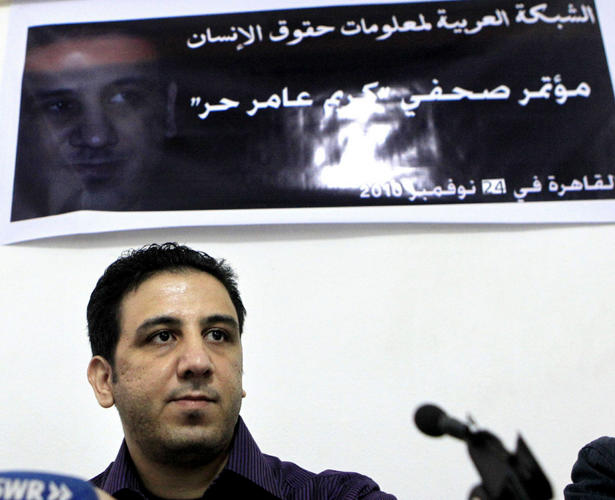
CyberDissidents.org has just received word that Egyptian blogger Kareem Amer, recently released after four years in prison, has disappeared.  Kareem is a member of CyberDissidents.org’s blogger board and we are horrified at this news. Last night around 11 pm Kareem left Tahrir square with a friend.  They were warned not to go through Kasr Elnil because of ambushes and arrests there.  It is not known if they used that exit, but Kareem and his friend have not been heard from since.  Their phones are off and they are not in their apartments.  “Mubarak has started to hunt us down,” a friend of Kareem’s told CyberDissidents.org.  “One more week in power and he will kill us all.” Kareem is a sensitive soul who wants nothing more than to live in freedom.  Yesterday, he spoke with CyberDissidents.org and urged us to continue highlighting violations of human rights in Egypt.  A few weeks ago, we asked Kareem about his four years in prison.  “Freedom is worth the sacrifice,” he said. Please spread the word about Kareem’s disappearance to friends, family, press and policy-makers.

For More >CLICK HERE<

Egypt: ‘Omar Suleiman was part of the old system. We want a new system’

The news dribbled in to Tahrir Square in phone calls, text messages, by word of mouth. The details were vague but the demonstrators, some of whom have been camped in the square for nearly a fortnight, agreed that concessions offered by the man who increasingly appears to run Egypt, the vice president and former intelligence chief Omar Suleiman, were a good sign. The regime was crumbling. But what of President Hosni Mubarak? The news was disappointing. Tens of thousands of people packed in to Tahrir Square again, as determined now to rid Egypt of the man who has ruled for 30 years as they were when the uprising began nearly a fortnight ago. Some welcomed news of talks between Suleiman and opposition figures as further evidence that the regime’s power is waning. But they still wanted to see the protests through until their central demand – for Mubarak’s resignation – has been met. Many were wary of the apparent deal being cooked up between Washington and Suleiman, with European backing, for the old regime to oversee the transition to democracy.

For More >CLICK HERE<

US Patriot Act

SNEAK AND PEEK SEARCH  WARRANTS

Published in slightly different form in Flagpole Magazine, p. 12 (September 11, 2002).

Author: Donald E. Wilkes, Jr., Professor of Law, University of Georgia School of Law.

In his recent article “Taking Liberty with Freedom,” author Richard P. Moore reminds us that the USA Patriot Act, signed by President Bush last Oct. 26 in the wake of the Sept. 11 terrorist attacks, “gives the government the kind of sweeping powers of arrest, detention, surveillance, investigation, deportation, and search and seizure that … assault … our most basic freedoms.”

“No hearings were held in either the House or Senate on the USA Patriot Act,” legal scholar John Dean tells us, “and few–if any–members of Congress were really aware of what was actually in this massive, complex, highly technical 30,000 word statute, which is divided into ten titles, with more than 270 sections and endless subsections that cross-reference and amend a dozen or more different laws.”

I want to examine here a single section of the USA Patriot Act–section 213, definitely one of the most sinister provisions of this monstrous statute.

In euphemistic language that conceals the provision’s momentous significance, section 213 states that with regard to federal search warrants “any notice required … to be given may be delayed if … [1] the court finds reasonable cause to believe that providing immediate notification of the execution of the warrant may have an adverse result …; [2] the warrant prohibits the seizure of any tangible property …  except where the court finds reasonable necessity for the seizure; and [3] the warrant provides for the giving of such notice within a reasonable period of its execution, which period may thereafter be extended by the court for good cause shown.”

Section 213 may be couched in Orwellian terminology, but there is no doubt about what it does.

Section 213 is the first statute ever enacted in the history of American criminal procedure to specifically authorize an entirely new form of search warrant-what legal scholars call the sneak and peek warrant (also dubbed the covert entry warrant or the surreptitious entry warrant).  A sneak and peek search warrant authorizes police to effect physical entry into private premises without the owner’s or the occupant’s permission or knowledge to conduct a search; generally, such entry requires a breaking and entering.

In authorizing search warrants to be served stealthily sneak and peek warrants are a radical departure from conventional search warrants.

Inhabitants of premises searched under a conventional warrant know of the search either at the time it occurs or shortly thereafter.  This is because traditionally search warrants have been executed openly and at a time when the inhabitants of the premises searched are present.  Conventional search warrants authorize the seizure of physical objects (such as drugs or stolen property); if such articles are found and taken away by police the occupants will certainly know it.  (Indeed, if  possession of the articles is illegal, the occupants will be arrested on possession charges.)  In addition, conventional search warrants require police to give a copy of the warrant and a receipt for any items seized to the persons present on the premises, or else leave the copy and the receipt on the premises.  In those instances where no one is present when the warrant is served the occupants will nevertheless usually soon be aware of the search and seizure: there will be signs of a forcible entry; the premises will have been ransacked and any seized items will be missing; and a copy of the warrant and the receipt will be on the premises.

The regime of sneak and peek warrants is drastically different.  We know this because in the 1980’s the FBI and the DEA managed, incredibly, to persuade certain federal judges to issue at least 35 sneak and peek warrants, despite the absence of any statutory authorization for such warrants at the time; and there are five reported federal appellate court decisions detailing the facts concerning the issuance and execution of such warrants.

Under a sneak and peek warrant the search occurs only when the occupants are absent from the premises.  The entry, search, and any seizures are conducted in such a way as to keep them secret.  The search and seizure focus on obtaining intangibles, i.e., information concerning what has been going on, or now is inside, the premises.  Photographs may be taken.  Usually, no physical objects are removed.  If objects are removed this is accomplished in such a way that the removal remains clandestine; for example, an item seized might be replaced with another item that appears to be the original.  No copy of the warrant or receipt is left on the premises.  Sometimes the same premises is subjected to repeated covert entries under successive warrants.  Generally, it will not be until after the police make an arrest or return with a conventional search warrant that the existence of any covert entries is disclosed.  This may be weeks or even months after the surreptitious search or searches.

Although section 213, like the USA Patriot Act itself, was ostensibly designed to suppress terrorism, the section is not restricted to terrorists or terrorism offenses; it may used in connection with any federal crime, including misdemeanors.  Section 213 also is exempted from the Act’s sunset provisions and therefore will remain on the books permanently unless repealed.  Although section 213 governs federal search warrants, it only a question of time before states begin enacting legislation authorizing state and local police to obtain sneak and peek warrants from state judges.

If a sneak and peek warrant targets a person who, as it turns out, is in fact innocent and the search uncovers nothing criminal, it is unlikely that the victim of the search will ever find out about it.

Exactly who, after all, is going to make sure that police notify such a person of the search?  At any rate, police will rarely admit that an innocent person was subjected to a covert search, even when it did happen, because police can be counted on, whenever they deem it necessary to protect themselves, to plant evidence or to testify falsely as to what they observed.  Where the search is surreptitious and the occupants are not present to observe the search the potential for police abuse is limitless.  The widespread problem of lawlessness in law enforcement in this country will simply become exacerbated under a system where police learn at the police academy how to clandestinely burglarize the premises of Americans.

It may also be expected that over time the use of sneak and peek warrants will tend to become common rather than exceptional.  Search warrants are issued on an ex parte basis; at the time a warrant is issued no one knows that police have requested it, or that a judge has granted the request, except the police and the judge.  The judges who issue search warrants are usually low-level magistrates who rubberstamp whatever police request, and police constantly strive to expand their power by using increasingly aggressive investigative techniques.

Furthermore, the history of American criminal procedure conclusively shows that intrusive investigative procedures which police claim they to need to use on special occasions to deal with the worst criminals soon become standard operating procedures used against ordinary suspects.

Take, for example, the use of no-knock search warrants in Georgia.  These warrants, which permit police to burst into occupied homes unannounced, came into existence because police claimed there were some dangerous criminals who would resist entry or destroy evidence if (as traditionally has been required) police were to announce their purpose and authority before forcibly entering to execute a conventional search warrant.  But no-knock search warrants (which, despite their frequent use, are not authorized by statute in this state) have become the rule instead of the exception in Georgia.  Over a decade ago the Georgia Court of Appeals pointed out that such warrants “simply have become customary … in drug cases.”  (The overwhelming majority of all search warrants involve drugs.)  Even here in Clarke county, in 1997 (the latest year for which I have statistics), 69 of the 143 search warrants issued (48%) had a no-knock provision (every one of which was based entirely on  boilerplate allegations by police about drug offenders generally rather than any specific facts of the particular case).

Undoubtedly section 213 will be challenged in court on grounds it violates Fourth Amendment protections against unreasonable searches and seizures.  However, the federal courts are packed with statists and majoritarians appointed by Nixon, Reagan, and both Bushes for the specific purpose of narrowing “the right of criminals” and strengthening “the peace forces.”  These judges have, with a few exceptions, displayed unremitting hostility to Fourth Amendment rights, handing down decision after decision expanding police investigative powers at the expense of individual privacy.  In 1979, in one of worst Fourth Amendment decisions of all time, the U. S. Supreme Court upheld the validity of covert entries into private premises by federal police to install court-authorized listening devices, even though the federal electronic surveillance statute is starkly silent on the issue of covert entries.  Law reviews are now filled with articles with such titles as “The Incredible Shrinking Fourth Amendment” and “The Court That Devoured the Fourth Amendment.”  There is, therefore, no possibility that the federal courts will hold sneak and peek warrants to violate the Fourth Amendment.

Nearly two decades ago a courageous federal judge, in a dissenting opinion, warned that sneak and peek search warrants “constitute … a dangerous and radical threat to civil rights and to the security of all our homes and persons.”  Echoing this sentiment, an article in the San Diego Law Review several years later emphasized that sneak and peek search warrants “bestow on law enforcement agents unlimited license to rifle through a person’s private residence without the owner’s knowledge or consent.  There is no check on agents’ actions to ensure they comply” with protections for individual rights, and “the risk of abuse and the subsequent intrusion into privacy is … severe.”

Until Congress repeals it, section 213 means that from now on Americans will, in the words of another law review article, published in the Stanford Law Review, be forced to live in “Orwellian fear that government agents may intrude secretly at any time.”

(ARTICLE) Last updated 17 September 2009 22:14:28

Patriot Act vs Constitution

US Constitution (Bill of Rights)

Amendment IV: The right of the people to be secure in their persons, houses, papers, and effects, against unreasonable searches and seizures, shall not be violated, and no warrants shall issue, but upon probable cause, supported by oath or affirmation, and particularly describing the place to be searched, and the persons or things to be seized.

US Patriot act

Freedom from unreasonable searches: The government may search and seize Americans’ papers and effects without probable cause to assist terror investigation.

US Constitution (Bill of Rights)

Amendment VI: In all criminal prosecutions, the accused shall enjoy the right to a speedy and public trial, by an impartial jury of the state and district wherein the crime shall have been committed, which district shall have been previously ascertained by law, and to be informed of the nature and cause of the accusation; to be confronted with the witnesses against him; to have compulsory process for obtaining witnesses in his favor, and to have the assistance of counsel for his defense.

US Patriot act

Right to a speedy and public trial: The government may jail Americans indefinitely without a trial.

US Constitution (Bill of Rights)

Amendment I: Congress shall make no law respecting an establishment of religion, or prohibiting the free exercise thereof; or abridging the freedom of speech, or of the press; or the right of the people peaceably to assemble, and to petition the government for a redress of grievances.

US Patriot act

Freedom of association: To assist terror investigation, the government may monitor religious and political institutions without suspecting criminal activity.

US Constitution (Bill of Rights)

Amendment VI: … to have compulsory process for obtaining witnesses in his favor, and to have the assistance of counsel for his defense.

US Patriot act

Right to legal representation: The government may monitor conversations between attorneys and clients in federal prisons and deny lawyers to Americans accused of crimes.

US Constitution (Bill of Rights)

Amendment I: Congress shall make no law … abridging the freedom of speech …

US Patriot act

Freedom of speech: The government may prosecute librarians or keepers of any other records if they tell anyone the government subpoenaed information related to a terror investigation.

US Constitution (Bill of Rights)

Amendment VI: … to be confronted with the witnesses against him …

US Patriot act

Right to liberty: Americans may be jailed without being charged or being able to confront witnesses against them. US citizens (labeled “unlawful combatants”) have been held incommunicado and refused attorneys.